The automobile industry runs on precision, speed, and massive volumes of water. From stamping metal sheets to washing painted vehicle bodies, every production stage generates contaminated water that cannot be discharged untreated. This makes automobile industry wastewater treatment not just an environmental obligation, but a critical part of operational compliance, cost control, and brand reputation.
Automotive manufacturers today face strict pollution norms, rising water scarcity, and increasing pressure to adopt sustainable practices. Treating wastewater effectively allows plants to reduce freshwater consumption, recover valuable oils, and prevent toxic discharges into rivers and soil. With the right engineering approach, wastewater management becomes a strategic advantage rather than a regulatory headache.
What Are The Major Sources Of Wastewater In Automobile Manufacturing?
Understanding what are the major sources of wastewater in automobile manufacturing? is the first step toward designing a compliant treatment system. Automotive plants use water at almost every production stage, and each step introduces a different type of pollutant.
1. Metal Processing and Machining
During cutting, grinding, and shaping of metal components, large volumes of coolant and lubricating oil are used. These fluids get washed off and enter wastewater streams, creating:
Oil and grease contamination
Suspended metal particles
High Chemical Oxygen Demand (COD)
This type of wastewater cannot be sent directly to biological treatment because oil coats bacteria and blocks oxygen transfer.
2. Vehicle Washing and Surface Preparation
Before painting, vehicle bodies go through multiple washing and degreasing stages. These processes generate wastewater containing:
Detergents and surfactants
Dirt, rust, and fine solids
Residual oils and waxes
Without proper pre-treatment, these contaminants interfere with downstream treatment systems.
3. Painting and Coating Operations
Paint booths and coating lines are one of the most complex wastewater sources. They produce water contaminated with:
This stream often forms thick, sticky paint sludge that needs specialized handling.
4. Cooling and Utility Water
Cooling towers, boilers, and scrubbers discharge water containing:
Corrosion inhibitors
Biocides
Dissolved salts
If left untreated, these chemicals accumulate in receiving water bodies and cause long-term ecological damage.
Together, these streams make automotive effluent highly variable and difficult to treat without a well-designed wastewater and water treatment strategy.
Why Do Oil, Grease, And Paint Sludge Require Special Treatment?
Many engineers ask why do oil, grease, and paint sludge require special treatment? The answer lies in how these pollutants behave in water and how they impact treatment systems.
Oil and Grease Are Not Just Floating Layers
In automotive wastewater, oils are often present as emulsions rather than free-floating layers. These tiny oil droplets:
Do not separate naturally
Pass through basic sedimentation tanks
Block oxygen transfer in biological reactors
Even a few parts per million of oil can cause treatment plant failure if not removed early.
Paint Sludge Is Chemically Complex
Paint sludge is a mixture of pigments, resins, solvents, and heavy metals. It is:
Sticky and hard to dewater
Often classified as hazardous waste
Capable of releasing toxic compounds into soil and groundwater
This makes paint sludge management a regulatory and environmental risk.
Grease Creates Operational Problems
Grease solidifies at lower temperatures and sticks to pipes, tanks, and sensors. This leads to:
If grease enters biological treatment, it forms scum layers that reduce treatment efficiency.
This is why advanced pre-treatment using mechanical separation and chemical wastewater treatment is essential in automotive plants.
How Can Oil-Water Separators Improve Automobile Effluent Quality?
A key question in plant design is how can oil-water separators improve automobile effluent quality? These systems act as the first line of defense against oil and grease pollution.
What Oil-Water Separators Actually Do
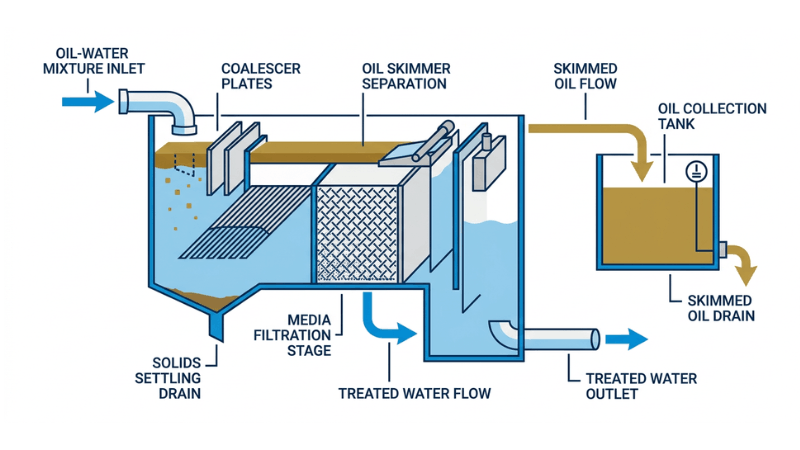
Oil-water separators use gravity, coalescing media, and engineered flow patterns to separate oil droplets from water. In automotive effluent, they:
By removing oil early, the entire treatment plant becomes more stable and efficient.
Real-World Impact in Automotive Plants
In one automotive assembly plant, installing a high-efficiency oil-water separator before the main treatment plant resulted in:
70% reduction in oil content
40% lower chemical usage in downstream treatment
Fewer biological reactor failures
This shows that mechanical separation is not just an accessory, it is a performance multiplier.
Integration With Complete Treatment Systems
Oil-water separators are typically followed by:
Dissolved Air Flotation (DAF)
Chemical coagulation and flocculation
Biological treatment or membrane systems
Together, these create a robust automobile industry wastewater treatment system capable of meeting even the most stringent discharge norms.
Why Compliance Is Non-Negotiable for the Automobile Industry
Environmental regulators worldwide now impose heavy penalties for untreated or poorly treated industrial discharge. Automotive manufacturers face risks such as:
But beyond regulation, customers and investors are also demanding greener manufacturing.
A modern wastewater treatment system enables:
This turns compliance into a long-term financial and environmental win.
Designing a Sustainable Treatment Strategy
A high-performing automotive wastewater treatment system should include:
Source segregation of different effluent streams
Oil-water separation at the front end
Chemical and physical treatment for paint and grease
Advanced polishing for water reuse
When designed correctly, plants can recycle up to 70–80% of their process water.
This aligns perfectly with circular economy goals and global sustainability benchmarks.
Conclusion
Automobile manufacturing produces some of the most complex industrial wastewater, filled with oils, paints, chemicals, and fine solids. Understanding what are the major sources of wastewater in automobile manufacturing, why do oil, grease, and paint sludge require special treatment, and how can oil-water separators improve automobile effluent quality is essential for building compliant and efficient treatment plants.
With the right engineering, automotive companies can transform wastewater from a liability into a reusable resource. By integrating mechanical separation, chemical treatment, and biological polishing, manufacturers not only meet environmental regulations but also build a more resilient, sustainable operation.
Frequently Asked Questions(FAQs)
Q1. What are the major sources of wastewater in automobile manufacturing?
A: They come from metal machining, vehicle washing, paint booths, and cooling systems. These processes introduce oils, chemicals, detergents, and paint solids into water streams that require advanced treatment.
Q2. Why do oil, grease, and paint sludge require special treatment?
A: These pollutants do not settle naturally and interfere with biological processes. Without proper removal, they cause blockages, system failures, and environmental contamination.
Q3. How can oil-water separators improve automobile effluent quality?
A: They remove free and dispersed oils before the water reaches chemical or biological treatment. This improves efficiency, reduces chemical use, and protects downstream equipment.
Q4. Is automobile wastewater suitable for reuse?
A: Yes, with proper treatment. Modern automobile industry wastewater treatment systems can recycle water for washing, cooling, and utility purposes.
Q5. How does chemical wastewater treatment support automotive plants?
A: Chemical wastewater treatment helps break emulsions, remove paint particles, and reduce toxic compounds, making the effluent safe for biological treatment or discharge.