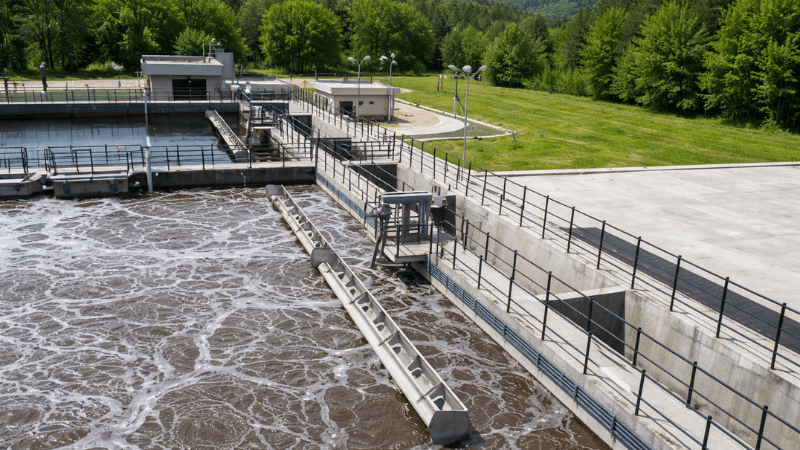
Modern wastewater treatment plants are designed to maximize efficiency, reduce operational costs, and meet increasingly strict discharge standards. In sequencing batch reactor (SBR) systems and many sewage treatment plants (STPs), one critical component that directly influences treated water quality is the floating decanter.
By ensuring controlled withdrawal of clarified water without disturbing settled sludge, floating decanter systems significantly enhance treatment performance.
What Is A Floating Decanter In Wastewater Treatment?
To understand what is a floating decanter in wastewater treatment, it is important to first look at the decanting stage in biological treatment systems.
In SBR-based systems, treatment occurs in batches inside a single reactor. After aeration and settling phases are completed, the treated supernatant (clear water layer) must be removed carefully without disturbing the sludge blanket at the bottom.
A floating decanter is a mechanical device designed specifically for this purpose.
Core function
A floating decanter:
Withdraws clarified water from the top layer
Maintains a constant intake level relative to the water surface
Prevents sludge carryover
Ensures stable effluent quality
Unlike fixed decanters, floating models adjust automatically to changing water levels during discharge.
Key components of a floating decanter system
Typical floating decanter assemblies include:
Floating arm or buoyant structure
Decanter weir or intake pipe
Flexible hose or swivel joint
Actuation mechanism (manual or motorized)
Anti-vortex and scum baffle features
These elements work together to ensure smooth and controlled discharge.
In many modern wastewater and water treatment systems, floating decanters are standard components in SBR configurations.
How Does A Floating Decanter Work During Decanting Processes?
The decanting phase is one of the most sensitive steps in batch treatment systems. Any disturbance can re-suspend settled sludge and reduce effluent clarity.
Understanding how a floating decanter works during decanting processes highlights why this component is critical.
Step 1: Settling phase completion
After aeration stops:
Biomass settles at the bottom
A clear supernatant layer forms above
Sludge blanket stabilizes
The decanter remains in standby during this phase.
Step 2: Controlled lowering into the supernatant
When decanting begins:
The floating arm gradually lowers
The intake remains just below the water surface
Only clarified water is drawn
Because the decanter floats, it automatically follows the decreasing water level.
Step 3: Surface skimming prevention
Floating decanters are designed with:
These features prevent:
Surface scum entry
Air entrainment
Turbulence formation
This ensures effluent consistency and minimizes suspended solids.
Step 4: Gradual discharge without hydraulic shock
The discharge rate is controlled to:
Prevent sludge blanket disturbance
Avoid hydraulic shock to downstream units
Maintain effluent stability
Because SBR systems operate cyclically, maintaining predictable decant rates improves overall plant performance.
Step 5: Automatic reset for next cycle
After discharge:
This automation allows reliable and repeatable operation.
This full sequence explains how a floating decanter works during decanting processes in practical applications.
Why Are Floating Decanters Preferred In SBR And STP Plants?
SBR and STP plants rely heavily on efficient batch discharge systems. Fixed withdrawal systems often introduce operational risks.
1. Superior effluent quality control
Floating decanters withdraw water from the cleanest layer – the upper clarified zone.
This reduces:
Stable effluent quality directly supports regulatory compliance.
2. Adaptability to variable water levels
In SBR systems, water levels fluctuate significantly during fill and decant phases.
Floating decanters:
Automatically adjust to water level changes
Maintain consistent intake depth
Eliminate manual intervention
3. Reduced mechanical complexity inside the tank
Unlike bottom-draw systems, floating decanters:
This improves long-term reliability.
4. Improved process efficiency
By preventing sludge carryover:
Downstream filtration loads are reduced
Disinfection performance improves
Sludge recycling remains stable
This enhances overall wastewater and water treatment efficiency.
5. Lower maintenance requirements
Well-designed floating decanter wastewater systems offer:
Simple mechanical structure
Accessible maintenance points
Reduced corrosion exposure
Long operational life
These key operational advantages make floating decanters the industry standard for SBR and STP systems worldwide.
Integration With Broader Treatment Systems
Floating decanters are most commonly used in:
Municipal sewage treatment plants (STPs)
Industrial SBR systems
Food processing wastewater facilities
Decentralized wastewater treatment units
They often work alongside:
In cases where industrial wastewater contains complex contaminants, floating decanters may operate as part of combined biological and chemical wastewater treatment processes.
Operational Benefits Of Floating Decanter Systems
From a performance standpoint, floating decanters contribute to:
These advantages make them essential components in modern batch treatment plants.
Design Considerations For Floating Decanters
When selecting a floating decanter system, engineers consider:
Proper hydraulic design ensures optimal performance during decant cycles.
Conclusion
Floating decanter systems play a critical role in improving wastewater treatment efficiency, particularly in batch-operated SBR and STP plants. By enabling controlled, surface-level withdrawal of clarified water, they protect sludge stability, maintain consistent effluent quality, and reduce operational disturbances. Their ability to adapt to changing water levels while minimizing mechanical complexity makes them a reliable and efficient solution in modern wastewater and water treatment systems. When integrated into well-designed biological processes, floating decanters significantly enhance plant performance and long-term treatment reliability.
Frequently Asked Questions(FAQs)
Q1. What is a floating decanter in wastewater treatment?
A: A floating decanter is a mechanical device used in SBR systems to withdraw clarified supernatant water from the surface without disturbing settled sludge.
Q2. How does a floating decanter work during decanting processes?
A: It lowers gradually into the supernatant layer, floats with the water surface, and withdraws clarified water at a controlled rate while preventing sludge and scum entry.
Q3. Why are floating decanters preferred in SBR and STP plants?
A: They maintain consistent effluent quality, adjust automatically to changing water levels, and minimize sludge disturbance during decant cycles.
Q4. Are floating decanters suitable for industrial wastewater?
A: Yes. Floating decanter wastewater systems can be used in industrial SBR plants, including those integrating chemical wastewater treatment processes.
Q5. Do floating decanters require frequent maintenance?
A: Generally, they require low maintenance when properly designed, as they have fewer submerged mechanical components compared to fixed decant systems.