Effective oil and grease removal is the cornerstone of industrial wastewater compliance — it prevents toxic buildup, protects biological treatment systems, and ensures effluent meets discharge standards. Industries that manage oily wastewater proactively reduce regulatory risk, lower treatment costs, and contribute to cleaner water bodies. Understanding and implementing the right removal strategy is essential for any facility aiming for consistent compliance.
Oil contamination in industrial effluent is one of the most persistent compliance challenges across manufacturing, food processing, and petrochemical sectors. Without proper removal, oil and grease interfere with downstream biological processes, clog infrastructure, and elevate BOD and COD levels beyond permissible limits. Understanding where oil contamination originates, why it must be removed before biological treatment, and how oil-water separators work forms the foundation of any effective wastewater management programme.
What Are The Main Sources Of Oil And Grease In Industrial Effluent?
This section identifies the primary industries and process points that introduce oil and grease into wastewater streams. Understanding the source is the first step toward selecting the right treatment approach.
Oil and grease enter industrial effluent from a wide range of operational activities. The type and concentration of contamination vary significantly by industry, making source identification critical for treatment design.
Key Industrial Sources
Petroleum and Petrochemical Facilities: Refineries and petroleum storage sites generate large volumes of oily wastewater. Hydrocarbon spills, tank washings, and process condensates are primary contributors. Free and emulsified oils are commonly present in high concentrations at these facilities.
Food and Beverage Processing: Cooking oils, animal fats, and dairy residues are discharged during cleaning and processing operations. These organic oils create high FOG (Fats, Oils, and Grease) loads that elevate BOD significantly.
Metal Fabrication and Machining: Cutting fluids, lubricants, and coolants used in machining processes carry emulsified oils into wastewater. These are particularly difficult to treat due to the stable emulsions formed with surfactants.
Automotive and Transport Industries: Vehicle wash bays, engine repair workshops, and fleet maintenance facilities introduce petroleum-based oils through runoff and equipment cleaning.
Textile and Dyeing Units: Textile manufacturing uses mineral oils and sizing agents that contribute to oil water pollution and raise effluent treatment complexity.
Marine and Port Operations: Bilge water, fuel spills, and ship maintenance activities discharge oils directly or indirectly into industrial drainage systems.
Common oil forms found across these sources include:
Free oil — separates readily under gravity
Dispersed oil — fine droplets suspended in water
Emulsified oil — chemically stabilized, requiring coagulation or DAF for removal
Dissolved oil — present at molecular level, requiring advanced treatment
Accurate source mapping allows treatment engineers to recommend the most efficient combination of physical, chemical, and biological treatment technologies for each facility’s specific effluent profile.
Why Is Oil And Grease Removal Important Before Biological Treatment?
This section explains the critical role oil and grease removal plays in protecting biological treatment systems and maintaining treatment efficiency. Skipping this step leads to system failure, non-compliance, and increased operational costs.
Biological treatment systems — including activated sludge, sequencing batch reactors (SBRs), and moving bed biofilm reactors (MBBRs) — depend on healthy microbial populations. Oil and grease are toxic to these microorganisms when present above threshold concentrations.
Impact on Biological Treatment Systems
Inhibition of Microbial Activity: Oil coats bacterial cell surfaces, blocking nutrient uptake and oxygen transfer. This results in reduced biodegradation efficiency and rising effluent BOD/COD values.
Oxygen Transfer Interference: A thin film of oil on aeration tank surfaces reduces oxygen transfer rates significantly.
Oxygen transfer reduction: up to 40% in heavily contaminated systems
This forces facilities to increase aeration energy consumption just to maintain baseline dissolved oxygen levels.
Sludge Bulking and Foaming: Excess grease causes filamentous bacterial growth, leading to sludge bulking. Bulking sludge settles poorly, reducing the clarity of final effluent and increasing solids carryover.
Clogging of Biofilm Carriers and Media: In systems using plastic biofilm carriers or trickling filters, oil and grease clog the media surfaces. This reduces the effective surface area available for biofilm attachment.
Regulatory Consequences: Most pollution control boards and industrial discharge standards set strict limits on oil and grease content in effluent entering biological treatment or being discharged to sewers. Typical permissible limits range between 10–20 mg/L for direct discharge.
Exceeding these limits can result in:
Consent-to-operate violations
Increased monitoring requirements
Fines and penalties
Plant shutdown orders in severe cases
The importance of upstream oil and grease removal cannot be overstated. Protecting biological treatment investment starts at the pretreatment stage, and facilities that prioritise this step consistently outperform those that treat it as an afterthought.
Pre-Treatment Oil Removal: What Works
Effective pre-treatment typically combines:
API Oil-Water Separators — for free oil removal
Dissolved Air Flotation (DAF) — for emulsified and dispersed oil
Coagulation and Flocculation — for chemically stable emulsions
Oil Skimmers — for surface oil recovery in collection sumps
Each technology addresses a specific oil form, and designing them in the right sequence is key to reliable compliance.
How Do Oil-Water Separators Reduce Pollution Load Effectively?
This section covers the working principles, design types, and performance metrics of oil-water separators — one of the most effective and widely deployed technologies in oily wastewater treatment.
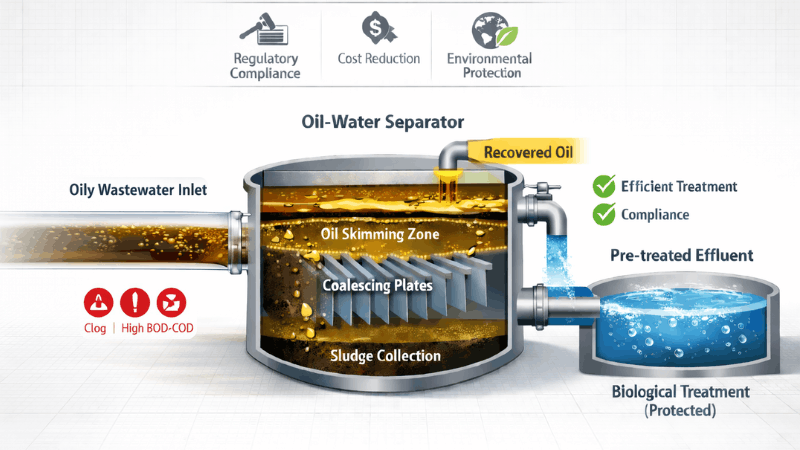
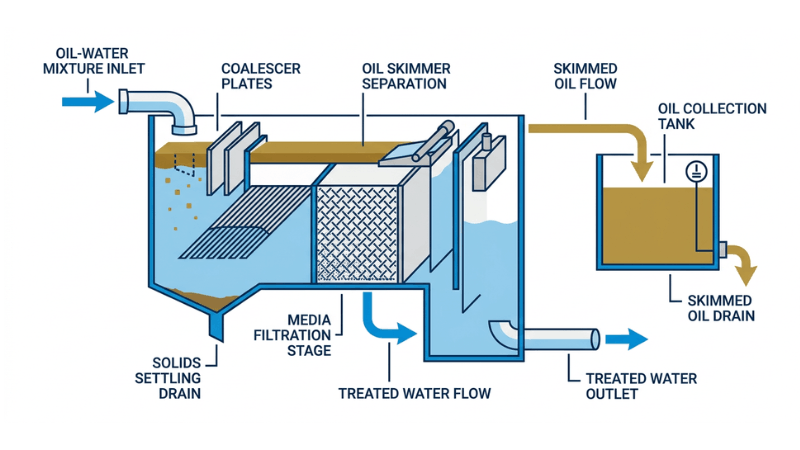
Oil-water separators function on the principle of density difference. Since oil is less dense than water, it naturally rises to the surface under controlled flow conditions, where it can be collected and removed.
Types of Oil-Water Separators
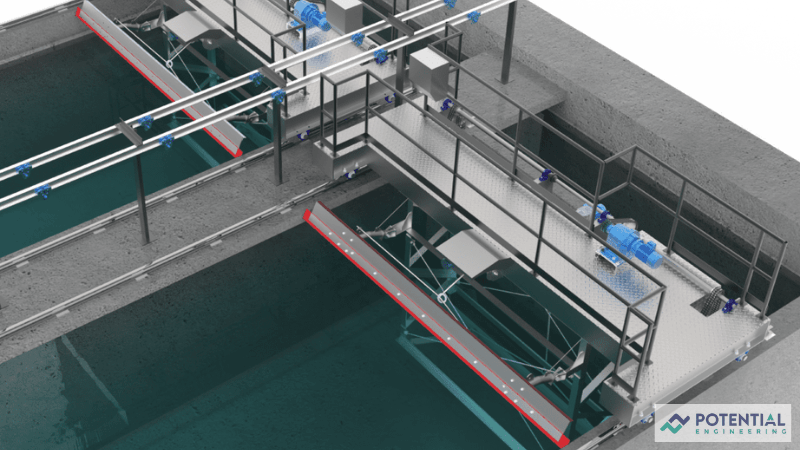
API (American Petroleum Institute) Separators: API separators are large, open-tank gravity separators designed for high-flow, free-oil applications. They are standard in refineries, tank farms, and large industrial facilities.
Flow velocity is controlled to allow oil droplets to rise
Sludge settles to the bottom for periodic removal
Suitable for free oil with droplet size above 150 microns
CPI (Corrugated Plate Interceptors): CPI separators use inclined corrugated plates to increase the effective settling area within a compact footprint.
Plate packs coalesce smaller oil droplets
Separation efficiency significantly higher than open API tanks
Suitable for emulsified oil with droplet size above 60 microns
TPI (Tilted Plate Interceptors): Similar to CPI units, TPI separators are used where space is constrained and higher throughput is needed.
DAF (Dissolved Air Flotation) Systems DAF systems inject micro-bubbles into wastewater, which attach to oil droplets and float them to the surface for skimming.
Removal efficiency: up to 95% for emulsified oils
DAF is particularly effective where chemical conditioning (coagulants and flocculants) is used upstream.
These reductions directly lower the load on downstream biological treatment systems, extending their operational life and reducing chemical consumption.
Why Separator Design Matters
Separator performance depends heavily on:
Hydraulic Retention Time (HRT) — sufficient time for separation
Flow rate control — turbulence disrupts oil rise
Temperature — higher temperatures reduce oil viscosity, aiding separation
Inlet distribution — uniform flow prevents short-circuiting
Separator systems must be designed based on thorough effluent characterisation data, site-specific flow rates, and the requirements of downstream treatment stages. This ensures consistent oil and grease removal performance across varying load conditions.
Conclusion
Oil and grease contamination remains one of the most technically demanding aspects of industrial wastewater management. Left unaddressed, it disrupts biological treatment, elevates pollutant loads, and puts facilities at serious risk of regulatory non-compliance.
The path to consistent compliance follows a clear logic. Identifying contamination sources accurately determines the right treatment technologies. Removing oil and grease before biological treatment protects microbial systems and prevents costly process failures. Deploying correctly designed oil-water separators — whether API, CPI, TPI, or DAF — reduces pollution load to levels that downstream systems can reliably handle.
Effective oily wastewater treatment is not a single-step intervention. It is a sequenced, engineered approach that begins at the source and extends through every stage of the treatment train. Facilities that invest in understanding this process and implementing appropriate pre-treatment measures consistently achieve better compliance outcomes, lower operational costs, and reduced environmental impact.
Ultimately, managing oil water pollution at the industrial level is both a regulatory obligation and an environmental responsibility. The technologies and principles covered in this article provide a practical foundation for any facility looking to strengthen its wastewater compliance posture.
FAQs
Q1. What are the main sources of oil and grease in industrial wastewater?
A: The primary sources include petroleum refineries, food processing units, metal fabrication workshops, automotive service facilities, and textile dyeing operations. Each source contributes different oil forms — free, dispersed, emulsified, or dissolved — which require different removal strategies. Identifying the source accurately is key to designing an effective oily wastewater treatment system.
Q2. Why must oil and grease be removed before biological treatment?
A: Oil and grease above threshold concentrations inhibit microbial activity, reduce oxygen transfer efficiency, and cause sludge bulking in biological treatment systems. These effects lead to rising BOD/COD in final effluent and potential consent violations. Effective upstream oil and grease removal protects the biological stage and ensures long-term treatment reliability.
Q3. How do oil-water separators work?
A: Oil-water separators exploit the natural density difference between oil and water, allowing oil droplets to rise to the surface under controlled hydraulic conditions. Different separator types — API, CPI, TPI, and DAF — are suited to different oil forms and concentration levels. Selecting the right separator type depends on effluent characteristics and the required outlet quality.
Q4. What is the typical oil and grease removal efficiency of a DAF system?
A: A well-designed Dissolved Air Flotation system, when combined with appropriate chemical conditioning, can achieve oil and grease removal efficiency of up to 95%. DAF is particularly effective for treating emulsified oils that cannot be separated by gravity alone.
Q5. What happens if oil and grease limits are exceeded in industrial discharge?
A: Exceeding permissible oil and grease limits in industrial effluent can result in consent-to-operate violations, increased regulatory scrutiny, financial penalties, and in severe cases, forced plant shutdowns. It also contributes to oil water pollution in receiving water bodies, harming aquatic ecosystems. Consistent pre-treatment and monitoring are essential to remain within compliance thresholds.