The food and beverage (F&B) industry is among the most water-intensive sectors worldwide, generating large volumes of complex wastewater. From dairy and beverage plants to meat processing, confectionery, and fast-food units, every operation produces effluents rich in organic matter, fats, oils, and suspended solids. Treating this diverse wastewater requires specialized solutions that address high pollutant loads, strict discharge norms, and the growing demand for water reuse and sustainability.
Key Pollutants in Food and Beverage Wastewater
Food and beverage wastewater contains a complex mix of pollutants arising from raw materials, processing, and cleaning operations. The following table highlights the major contaminant types, their sources, and impacts:
| Pollutant Type | Typical Source | Impact on Treatment / Environment |
| High Organic Load | Carbohydrates, proteins, fats from food ingredients | Raises BOD and COD levels, increasing treatment load |
| Suspended Solids (SS) | Food residues, pulp, peels, and particulates from washing and processing | Causes sludge buildup and clogging in treatment systems |
| Fats, Oils & Grease (FOG) | Dairy, meat, and snack industries | Forms scum layers, hinders aeration, and reduces treatment efficiency |
| Sugars & Starches | Beverage and confectionery units | Promote microbial growth, fermentation, and odor issues |
| Cleaning & Sanitizing Chemicals | Detergents, disinfectants, caustic soda from CIP systems | Alter pH and introduce inhibitory compounds affecting biological systems |
| Nutrients (Nitrogen & Phosphorus) | Dairy and meat processing wastewater | Lead to eutrophication if discharged untreated into natural water bodies |
| Temperature & pH Variations | Hot water cleaning and acidic residues | Affect microbial stability in biological treatment stages |
Advance Oil-Water Separation for Improved F&B Effluent Quality
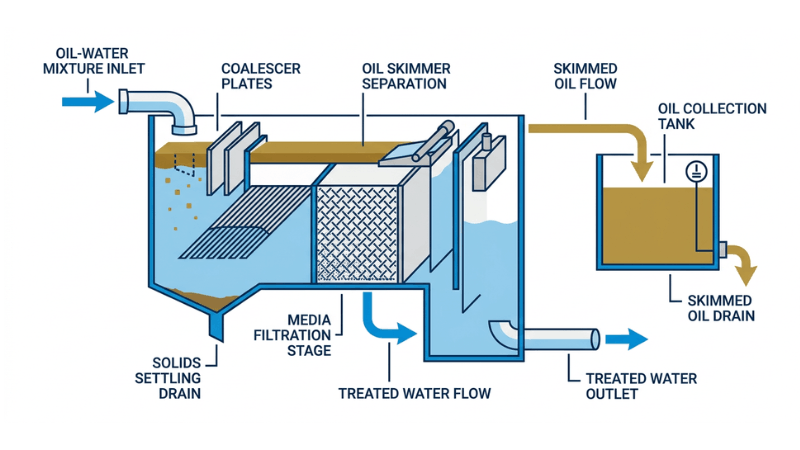
Effective oil-water separation is a crucial step in food and beverage wastewater treatment. While it may sound simple, its impact is far-reaching. The quality of oil removal directly influences the performance of every downstream treatment stage. By eliminating fats, oils, and grease early, it prevents clogging, reduces organic load, and stabilizes effluent quality. In short, efficient oil-water separation not only improves overall treatment efficiency but also ensures compliance, sustainability, and long-term operational reliability.
Key Benefits:
- Efficient Removal of Fats, Oils, and Grease (FOG):
Advanced oil-water separators remove both free and emulsified oils, preventing scum formation and equipment fouling. This significantly reduces COD and BOD levels in the treated water. -
- Enhanced Performance of Downstream Treatment:
Early removal of oil and solids allows biological and membrane-based systems to operate more efficiently, reducing maintenance frequency and extending membrane life. -
- Use of Modern Separation Technologies:
Coalescing plate interceptors (CPI), dissolved air flotation (DAF), and membrane-based oil-water separators deliver higher removal efficiency than traditional skimmers. These systems are compact, automated, and capable of handling variable loads. -
- Improved Reuse and Recycling Potential:
Cleaner effluent after oil separation can be reused in non-potable operations such as cleaning or cooling. This supports industries pursuing Zero Liquid Discharge (ZLD) and broader sustainability goals. -
- Reduced Sludge Generation and Disposal Costs:
Efficient oil removal minimizes sludge formation, lowering handling and disposal costs while reducing the plant’s environmental footprint. -
- Compliance and Brand Value:
Consistent discharge quality helps companies meet local regulations and international sustainability standards, enhancing reputation, especially in export markets. -
Did you know India’s new Liquid Waste Management Regulations are aiming at ambitious reuse goals for bulk water users like food and beverage industries to recycle 20% of treated wastewater by 2027–28 and 50% by 2030–31?
The food and beverage industry’s wastewater is among the most diverse and challenging to treat, demanding customized, multi-stage solutions. From tackling organic loads and FOG to meeting strict discharge norms, every process step requires precision and reliability. Advanced treatment technologies, especially those enhancing oil-water separation help industries optimize performance, cut operational costs, and move closer to water reuse and sustainability goals.
Importantly, today’s compact and modular systems make these technologies accessible not only to large plants but also to small and medium-scale F&B units, enabling them to achieve efficient treatment within limited space and budgets. In a sector where water is both a vital ingredient and a critical resource, investing in specialized wastewater treatment is not just compliance—it’s a strategic move toward long-term resilience and environmental stewardship.
Frequently Asked Questions (FAQs)
Q.1 Can skimmers alone handle FOG removal effectively in food and beverage wastewater?
A: Skimmers are useful for removing free-floating fats, oils, and grease (FOG) from the surface of tanks or settling units. However, they are not effective for emulsified oils or fine droplets commonly found in F&B wastewater. For comprehensive treatment and compliance with discharge standards, skimmers are usually combined with advanced oil-water separation technologies like coalescing plate separators, DAF units, or membrane-based systems.
Q.2 How do compact and modular treatment systems benefit urban F&B plants?
A: Compact and modular wastewater treatment systems are designed for limited space and variable loads, making them ideal for urban F&B plants. These systems are:
- • Space-efficient: Can be installed in small areas without large civil works.
- • Scalable: Easily adapted to plant capacity or production changes.
- • Low-maintenance and automated: Reduce operational effort and downtime.
- • Easy-to-operate: The plug-and-play model makes them easy to operate.
By adopting these systems, small and medium-scale plants can achieve efficient wastewater treatment, compliance, and water reuse even in constrained urban setups.
Q.3 How can treated wastewater be reused safely within a food or beverage facility?
A: Treated wastewater from F&B plants can be safely recycled for non-potable applications, helping conserve freshwater and reduce operational costs. Common reuse applications include:
- • Equipment and floor cleaning
- • Cooling towers or process cooling
- • Boiler feedwater (after further polishing if required)
To ensure safety and regulatory compliance, water must meet local discharge and reuse standards, and critical parameters like BOD, COD, FOG, and microbial counts must be monitored before reuse.
Q.4 How does a sludge recovery system for wastewater work?
A: A sludge recovery system for wastewater typically involves thickening, dewatering, and drying processes. The system separates solid sludge from liquid effluent, allowing the recovered water to be reused, while the treated solids can be processed further for energy generation or used as organic fertilizer.