The steel industry is water-intensive, generating around 16 m³ of wastewater per tonne of finished steel. This effluent is complex, often containing oil, suspended solids, and heavy metals that demand specialized treatment. Without proper management, it can harm ecosystems and lead to regulatory non-compliance. Effective treatment systems are therefore essential to safeguard the environment and enable water reuse.
Common Pollutants in Steel Industry Wastewater
The wastewater generated from steelmaking is as diverse as the processes themselves. In both the integrated route (blast furnace and basic oxygen furnace) and the non-integrated route (electric arc furnace), water is consumed for cooling, processing, and pollution control, resulting in different contaminant profiles across operations. An overview of these contaminants is as follows:
- • Coking operations are the most water-intensive, producing effluent rich in suspended solids, oil and grease, ammoniacal nitrogen, and organic matter. More hazardous components such as cyanides, thiocyanates, phenols, benzene, and polycyclic aromatic hydrocarbons also make coking wastewater particularly toxic.
-
- • Steelmaking processes like furnace cooling release wastewater loaded with fine suspended solids and a high thermal load, resulting in effluent that is both turbid and hot.
-
- • Finishing operations such as hot and cold rolling contribute scales, debris, and oil from lubricants, while acid pickling and electroplating discharge acidic wastewater containing heavy metals and residual chemicals.
-
From these diverse operations, steel effluent can broadly be grouped into:
- • Suspended solids – mill scale, dust, and slag particles from cooling and cleaning.
-
- • Oil and grease – lubricants and hydraulic oils from rolling mills and machinery.
-
- • Heavy metals – iron, zinc, chromium, nickel, and manganese from pickling and plating.
-
- • Acids and alkalis – from surface treatment and descaling.
-
- • Phenols and cyanides – traced back to coke ovens and gas-cleaning units.
-
- • High temperature and turbidity – due to cooling water discharges.
-
Why does the Steel Industry require Specialized Treatment Systems
Each pollutant in steel wastewater behaves differently, requiring a combination of technologies rather than a one-size-fits-all approach. The need for specialized systems can be understood through the following factors:
- • Varied nature of pollutants
- – Suspended solids require settling and filtration.
- – Oils and grease demand separation technologies.
- – Heavy metals and acids call for chemical or advanced physico-chemical treatments.
-
- • Presence of toxic compounds
- – Coking operations release phenols, cyanides, and hydrocarbons that are difficult to remove.
- – Cooling water adds a high thermal load, making effluent both turbid and hot.
-
- • Impact on operations and environment
- – Untreated pollutants corrode equipment, hinder water recycling, and damage ecosystems.
-
- • Regulatory compliance pressure
- – Strict discharge standards require careful monitoring of all pollutants. The CPCB has set national standards for effluent and emissions, requiring steel plants to monitor key parameters such as suspended solids, oil and grease, heavy metals, and other pollutants to ensure compliance.
- – Unit-specific processes, such as oxygen lancing, are regulated to limit emissions. According to CPCB guidelines, emissions from processes like oxygen lancing must be carefully monitored to control particulate matter and gaseous pollutants.
- – Integrated plants must operate within defined wastewater generation benchmarks per tonne of steel. CPCB standards outline permissible limits for various effluent parameters, effectively setting benchmarks for wastewater generation in integrated steel plants.
-
- • Need for sustainable water use
- – Multi-stage treatment systems allow steel plants to recover and reuse water, reducing freshwater demand and ensuring long-term sustainability.
-
Stages of Effluent Treatment in the Steel Industry
Steel industry effluent is complex to be treated in a single step. Instead, treatment is carried out in three progressive stages:
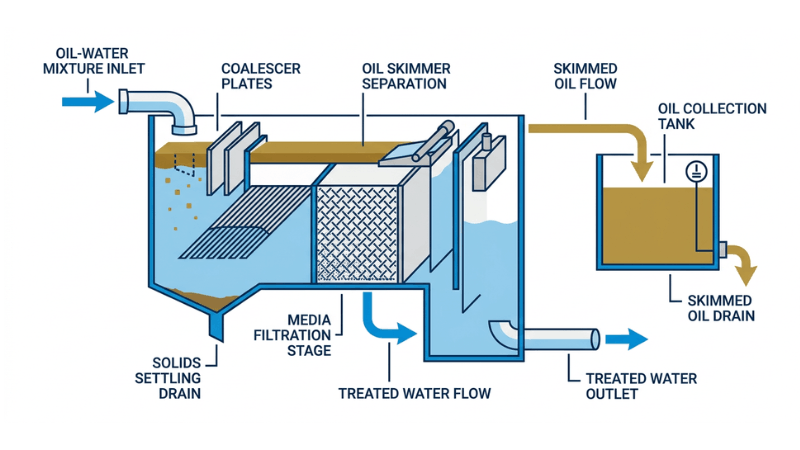
- • Primary Treatment – The first line of defence removes bulk pollutants such as suspended solids, slag particles, oils, and grease. Screens, grit chambers, oil–water separators, clarifiers, and equalization tanks ensure that the effluent is stabilized and manageable for the next stage.
-
- • Secondary Treatment – Biological processes such as activated sludge systems, sequencing batch reactors, or biofilm reactors reduce organic load, chemical oxygen demand (COD), and biological oxygen demand (BOD), while also addressing nitrogenous compounds.
-
- • Tertiary or Advanced Treatment – The final stage polishes the effluent to meet strict discharge or reuse standards. Filtration, advanced oxidation, membrane systems, or ion exchange remove residual heavy metals, salts, and toxic organics, while cooling systems bring down excess heat. This stage makes the water suitable for safe disposal or recycling.
-
Specialized Treatment in Steel Effluent Management
Every stage of effluent treatment plays a critical role, but certain operations demand dedicated recovery systems. For example, acid recovery units in pickling lines reduce the discharge of highly acidic wastewater by regenerating and reusing spent acids. Similarly, advanced oil removal systems are essential in cold-rolling operations where emulsified or soluble oils escape basic separation methods. These targeted technologies prevent downstream overload and protect sensitive biological and tertiary treatment units.
By combining conventional treatment with dedicated recovery processes, steel plants achieve both regulatory compliance and resource conservation, making wastewater management more efficient and sustainable.
Managing steel industry effluent is challenging, but with multi-stage treatment and dedicated recovery systems, plants can meet compliance, conserve resources, and reduce freshwater dependence. Wastewater treatment is therefore not just an environmental necessity but also a strategic advantage for the steel industry.
Note:
* https://cpcb.nic.in/generalstandards.pdf
Frequently Asked Questions(FAQs)
Q1. How do steel plants treat oily wastewater from rolling mills and machinery?
A: Steelmaking generates wastewater that often carries lubricants and hydraulic oils. To tackle this, plants use oil water separators (OWS) and advanced oil removal systems that capture both free-floating and emulsified oils. This prevents downstream fouling and improves the overall efficiency of effluent treatment.
Q2. What equipment is used to handle suspended solids in steel industry wastewater?
A: Cooling, cleaning, and furnace operations release mill scale, dust, and slag particles into wastewater. Clarifiers and sedimentation units are widely used to settle these suspended solids, while filters ensure cleaner water for recycling or safe discharge. Such systems are crucial for meeting strict discharge standards.
Q3. How is recycled water used in the steel industry?
A: Recycled water plays a vital role in reducing the industry’s freshwater demand. Once treated, it is reused mainly for cooling systems, dust suppression, slag quenching, and cleaning operations within the plant. In some cases, high-quality recycled water is also looped back into process stages like rolling mills or pickling lines, depending on purity requirements. By maximizing reuse, steel plants lower operating costs and contribute to long-term water security.
Q4. How does a sludge recovery system benefit wastewater plants?
A: A sludge recovery system improves efficiency by lowering disposal costs, reducing environmental pollution, and enabling resource recovery in wastewater plants.