As urban development accelerates and environmental regulations grow increasingly stringent, the demand for flexible and reliable wastewater treatment systems is more critical than ever. Among the proven technologies, the Sequencing Batch Reactor (SBR) stands out for its efficiency and consistency. With its time-based batch processing and precise control over each stage of treatment, the SBR system is particularly well-suited for areas experiencing fluctuating wastewater volumes and requiring compliance with strict discharge norms.
A Sequencing Batch Reactor (SBR) is a type of activated sludge process used in wastewater treatment. It operates as a fill-and-draw system, where all treatment steps occur sequentially in the same reactor tank.
Operational Cycle of an SBR
An SBR system operates in a sequential batch mode, completing all treatment stages in a single reactor. A typical cycle includes:
- 1. Fill – Wastewater is introduced into the tank. Depending on the system, this stage may involve mixing or aeration.
-
- 2. React (Aeration) – Oxygen is supplied to facilitate biological breakdown of organic matter and nutrients.
-
- 3. Settle – Aeration stops, allowing solids to settle and clarified water to rise.
-
- 4. Decant – The treated water is drawn off from the top without disturbing the sludge.
-
- 5. Idle (or Sludge Wasting) – The system either rests or removes excess sludge before the next cycle.
-
This structured, time-based approach allows for tight control over biological and chemical treatment processes.
Handling Variable Wastewater Loads
A major strength of SBRs is their ability to adapt to fluctuating inflows. Since treatment is batch-based, SBRs are not dependent on constant inflow, making them highly suitable for residential areas, seasonal industries, or decentralized systems.
- • During low flow periods, idle or aeration times can be extended, conserving energy while maintaining treatment balance.
-
- • During high inflow periods, cycle durations can be adjusted, or extra cycles added to manage increased volume.
-
Advanced SBRs often include automation and sensor controls, allowing real-time adjustments based on parameters like BOD, COD, or nitrogen levels. This dynamic responsiveness ensures stable treatment performance even under unpredictable loading conditions.
Advantages Over Conventional Treatment Systems
SBRs offer several advantages compared to traditional continuous flow systems:
- 1. Low Footprint: All treatment steps occur in one tank, saving space—ideal for urban installations or retrofitting.
-
- 2. High-Quality Effluent: Controlled settling and decanting result in clearer, cleaner discharge, with lower nutrient and solid content.
-
- 3. Flexible Operation: Batch cycles can be customized to match changing inflow volumes and pollutant levels.
-
- 4. Ease of Automation: With fewer mechanical parts and simpler workflows, SBRs are easier to automate and maintain. SCADA and PLC-based systems further enhance efficiency.
-
- 5. Integrated Nutrient Removal: SBRs support nitrification, denitrification, and phosphorus removal within the same cycle—something not easily achieved in conventional systems without multiple units.
-
- 6. Scalability: Systems can be scaled by adding more reactors or adjusting cycle durations, making them suitable for both small communities and large industrial applications.
-
- 7. Reduced Capital Costs: By integrating multiple treatment steps in one tank, SBR systems eliminate the need for separate clarifiers and other equipment, resulting in significant savings in construction and equipment costs.
-
With rising wastewater challenges and stricter discharge norms, Sequencing Batch Reactors offer a powerful combination of precision, adaptability, and performance. Their batch-mode operation enables consistent treatment quality across varying loads, while requiring less space and infrastructure than conventional systems. For municipalities, industries, and semi-urban regions seeking a reliable, scalable, and future-ready wastewater solution, SBR technology stands out as a preferred choice.
Frequently Asked Questions(FAQs)
Q.1 How does SBR sewage treatment work?
A. SBR sewage treatment works through a series of batch processes that include filling, aeration, settling, decanting, and idle phases. These steps occur in the same reactor tank, allowing for flexible control over treatment and high-quality effluent.
Q.2 What should you do first in the event of a chemical spill?
A. The first priority during a chemical spill is personal safety. Evacuate the area if necessary, notify others, and report the spill according to your facility’s emergency procedures. If trained, you may attempt to contain the spill using the proper safety gear.
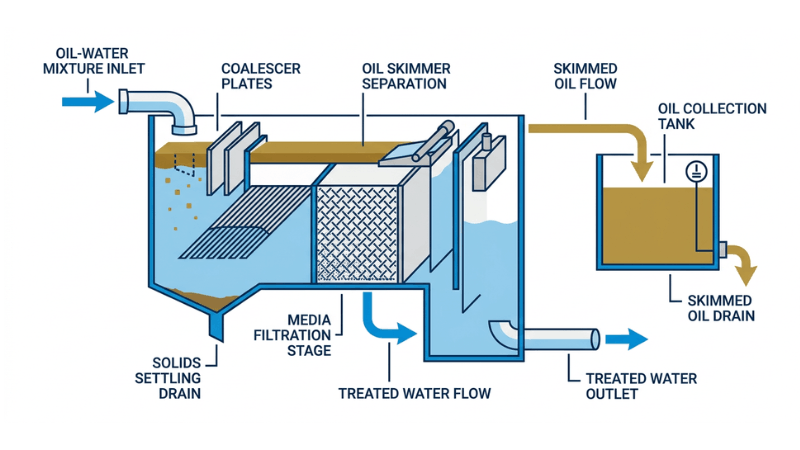
Q.3 Why is an oil water separator important in sewage treatment plants?
A. In sewage treatment plants, an oil water separator ensures that floating oils and grease do not interfere with biological or mechanical treatment processes. It helps protect equipment and supports environmental compliance by reducing oil discharge into water bodies.