The food and beverage (F&B) industry is one of the largest water consumers and wastewater generators in the industrial world. From dairies and breweries to snack plants and soft drink bottlers, every process step creates a unique, high-strength effluent that cannot be handled by conventional treatment alone.
This is exactly why food and beverage industry wastewater treatment demands advanced, process-specific solutions. High organic loads, fats and oils, variable flows, and strict discharge norms make “basic treatment” a fast track to compliance failure.
In this blog, we break down:
What types of organic pollutants are found in food and beverage wastewater
Why high COD is a major challenge in F&B effluent
How biological and oil-water separation systems reduce pollution load
All with practical engineering logic, not textbook theory.
The Nature of Food and Beverage Wastewater: Why It’s So Challenging
Unlike municipal sewage, F&B wastewater is:
Highly variable (batch processes, seasonal production)
Rich in biodegradable organics
Often loaded with fats, proteins, sugars, and suspended solids
Typical sources include:
Raw material washing
Process water and CIP (Clean-in-Place) systems
Floor washing and equipment cleaning
By-product and reject streams
This creates a wastewater profile that is:
High in BOD and COD
Rich in FOG (fats, oils, grease)
Nutrient-heavy (nitrogen, phosphorus)
Sometimes low in pH or high in temperature
Standard primary treatment is simply not enough.
This is exactly why the food and beverage industry wastewater treatment demands advanced, process-specific solutions designed for high organic loads, variable flows, and strict discharge norms..
What Types Of Organic Pollutants Are Found In Food And Beverage Wastewater?
Understanding what types of organic pollutants are found in food and beverage wastewater is the first step to designing the right treatment train.
The pollutant profile depends on the product category:
Carbohydrates and Sugars
Common in:
Breweries and distilleries
Soft drink and juice plants
Confectionery and bakery units
These are easily biodegradable but cause:
Proteins and Nitrogen Compounds
Typical in:
Problems caused:
Fats, Oils, and Grease (FOG)
Major sources:
FOG leads to:
Suspended Solids and Fibers
From:
Vegetable washing
Grain processing
Fruit pulping
These increase:
TSS load
Sludge production
Clarifier overload
Real-world insight:
In dairy and meat plants, COD often ranges from 3,000 to 10,000 mg/L, far higher than municipal sewage. Designing without accounting for this is asking for plant failure.
This is how modern wastewater treatment in the food and beverage sector moves from reactive operation to predictive, performance-driven process control.
Why Is High COD A Major Challenge In F&B Effluent?
If there is one parameter that defines F&B wastewater complexity, it is COD.
So, why is high COD a major challenge in F&B effluent?
Because COD directly controls:
Reactor sizing
Aeration energy
Sludge production
Compliance risk
Operating cost
What High COD Really Means
High COD indicates:
In F&B plants, COD spikes happen due to:
This creates:
Unstable biological performance
Bulking sludge and foaming
High power consumption in aeration
Engineering Impact of High COD
High COD leads to:
Oversized aeration systems
Increased blower energy (largest OPEX driver)
High sludge handling and disposal costs
Risk of non-compliance with discharge norms
Typical regulatory limits:
Bringing COD down from 8,000 to 100 mg/L is not a single-step job. It needs staged, advanced treatment.
This is why modern wastewater and water management in F&B relies on multi-barrier systems rather than single reactors.
How Can Biological And Oil-Water Separation Systems Reduce Pollution Load?
Now the real question:
How can biological and oil-water separation systems reduce pollution load effectively and sustainably?
The answer is: by attacking the load in the right sequence.
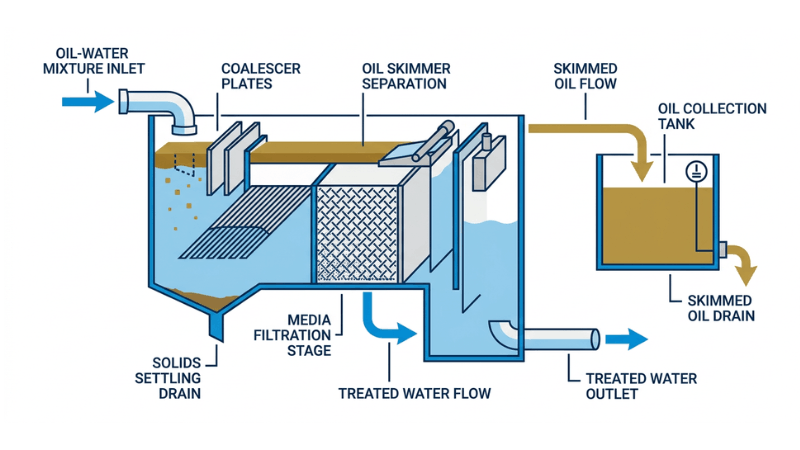
Step 1: Oil-Water Separation – Remove the Trouble First
Before biology, remove what kills biology.
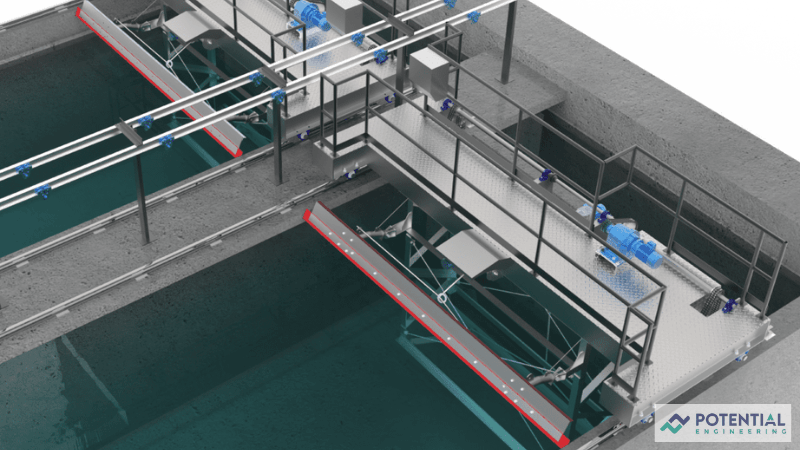
Oil-water separation systems such as:
Target:
Free oil
Emulsified fats
Floating solids
Benefits:
Protect downstream bioreactors
Reduce scum formation
Improve oxygen transfer efficiency
Cut COD by 20-40% upfront
Real example:
Installing a high-rate DAF ahead of biology in a dairy plant reduced influent COD from 6,000 to 3,800 mg/L and stabilized aeration instantly.
Step 2: Biological Treatment – Convert Organics into Biomass
Once fats and gross solids are removed, biological systems do the heavy lifting.
Common biological systems:
Activated Sludge Process (ASP)
Sequencing Batch Reactors (SBR)
Moving Bed Biofilm Reactors (MBBR)
Anaerobic reactors (UASB, EGSB)
How they reduce pollution load:
Convert soluble organics into biomass
Reduce BOD and COD by 85–95%
Enable nutrient removal when designed properly
Anaerobic + aerobic combination is the gold standard for high-COD F&B wastewater.
Advantages:
Anaerobic stage removes bulk COD and generates biogas
Aerobic stage polishes to discharge/reuse quality
Energy recovery offsets operating cost
This staged design is now core to advanced food and beverage industry wastewater treatment plants.
Step 3: Polishing and Reuse Systems
For zero liquid discharge or reuse:
Tertiary filtration
Membrane systems
Advanced oxidation
These ensure:
This is why integrated wastewater and water management in F&B plants now focuses on reuse, energy recovery, and long-term resource efficiency rather than simple disposal.
Design Principles for Advanced F&B Wastewater Treatment Plants
A high-performance F&B treatment plant follows these rules:
Equalization Is Non-Negotiable
Pretreatment First, Biology Second
Remove oils, fibres, grit upfront
Protect reactors and membranes
Modular and Scalable Design
Energy-Efficient Aeration
Automation and Monitoring
This is how modern wastewater treatment moves from reactive to predictive operation.
Sustainability and Compliance – The Business Case
Advanced treatment is not just about meeting norms. It directly impacts:
Freshwater intake reduction
Energy recovery through biogas
Lower sludge disposal volumes
ESG and sustainability reporting
Long-term operating cost stability
In many F&B plants:
That’s sustainability with a balance sheet impact.
Conclusion
Food and beverage wastewater is not “difficult” – it is different.
High organic loads, fats, proteins, and variable flows make conventional treatment unreliable and expensive.
By understanding:
What types of organic pollutants are found in food and beverage wastewater
Why high COD is a major challenge in F&B effluent
How biological and oil-water separation systems reduce pollution load
Engineers can design plants that are:
Stable
Energy-efficient
Compliant
Reuse-ready
Frequently Asked Questions(FAQs)
Q1. What types of organic pollutants are found in food and beverage wastewater?
A: Food and beverage wastewater contains sugars, proteins, fats, oils, grease, and suspended solids. These originate from raw material washing, processing losses, and cleaning operations, creating high BOD and COD levels.
Q2. Why is high COD a major challenge in F&B effluent?
A: High COD increases oxygen demand, energy consumption, sludge generation, and compliance risk. It also destabilizes biological systems if not reduced in stages through pretreatment and biological treatment.
Q3. How can biological and oil-water separation systems reduce pollution load?
A: Oil-water separation removes fats and floating solids first, protecting biological reactors. Biological systems then convert soluble organics into biomass, reducing BOD and COD by up to 95%.
Q4. Which biological system is best for food and beverage wastewater treatment?
A: Anaerobic-aerobic combinations are widely used for high-COD F&B wastewater. Anaerobic reactors remove bulk COD and generate biogas, while aerobic systems polish effluent to discharge or reuse standards.
Q5. Can treated F&B wastewater be reused safely?
A: Yes. With tertiary treatment and disinfection, treated wastewater can be reused for cooling, washing, and utilities, reducing freshwater intake and supporting sustainable wastewater and water management.