Oil skimmers remove floating oil, grease, and other surface contaminants from water by using a selective collection medium that attracts contaminants while minimizing water pickup. Tube oil skimmers are particularly useful where contaminants are dispersed across large or irregular surfaces, water levels vary, or installation space is limited.
Effective surface oil removal depends on more than simply placing a skimmer in a tank. The oil must be present as free-floating contamination, the tube must maintain suitable contact with the surface, and the collection system must continuously remove the material captured by the tube. Understanding the working mechanism, operating conditions, and differences between skimmer types helps determine where a tube skimmer is technically appropriate.
What Is a Tube Oil Skimmer?
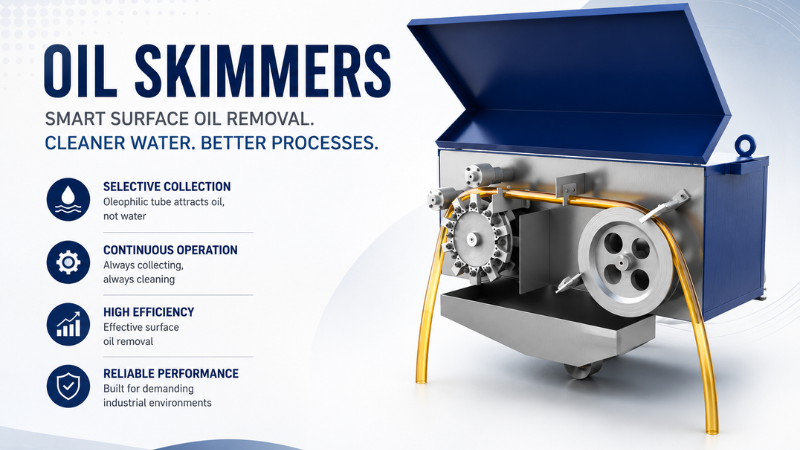
A tube oil skimmer is a mechanical surface oil removal device that uses a continuous, flexible, oleophilic tube to collect floating oil from water. Oleophilic means “oil-attracting,” describing a material that preferentially attracts and retains oil on its surface.
The tube travels through the contaminated water surface and picks up free-floating oil. A wiping or scraping mechanism then removes the collected oil from the tube and directs the recovered material into a collection container or sump.
The basic operating cycle consists of four stages:
The tube contacts the contaminated water surface.
Floating oil adheres to the oleophilic tube.
The oil-covered tube passes through a wiping mechanism.
The recovered oil flows into a collection point while the cleaned tube returns to the water surface.
This continuous cycle allows surface oil removal to continue as long as free oil remains available for collection.
How Do Tube Oil Skimmers Work?
Tube oil skimmers work through the difference in how oil and water interact with an oleophilic collection surface. The moving tube provides a surface to which floating oil preferentially adheres, allowing the contaminant to be physically separated from the water.
How Does the Floating Tube Collect Oil?
The tube remains at or near the water surface, where free-floating oil accumulates. As the tube moves slowly across the surface, oil adheres to its outer surface.
The tube’s movement can also help draw nearby floating oil toward the collection path. Because the tube is flexible, the collection path can extend across areas where a rigid collection device may have limited reach.
The process is fundamentally a form of mechanical oil-water separation. The skimmer doesn’t chemically break down the oil or convert emulsified oil into a removable form. Instead, the system targets oil that is already present as a separate floating phase.
How Is Oil Removed From the Tube?
After collecting oil, the tube passes through a set of wipers or scrapers. The wiping mechanism removes the accumulated oil from the tube surface and directs the recovered material toward a collection tray, tank, or sump.
The cleaned tube then returns to the contaminated water surface and begins another collection cycle.
This repeated pickup-and-wipe process is what allows a relatively small collection medium to perform continuous surface oil removal.
What Types of Contaminants Can Tube Skimmers Remove?
Tube oil skimmers are primarily designed for free-floating oils, but the actual contaminant profile depends on the application and operating conditions.
Common surface contaminants include:
Petroleum-based floating oils
Lubricating and hydraulic oils
Animal and vegetable oils
Grease and fats
Floating oily residues
Oleophilic skimmers are generally intended for contaminants that can separate from water and accumulate at the surface.
Emulsified oil presents a different treatment challenge. When oil droplets are finely dispersed throughout water rather than forming a separate surface layer, mechanical surface skimming alone may not provide the required separation.
When Are Tube Oil Skimmers Most Effective?
Tube oil skimmers are most effective when free-floating contamination is present and the operating environment allows the tube to maintain contact with the contaminated surface. Tank geometry, water depth, oil characteristics, debris levels, and required recovery rate all influence performance.
What Tank Conditions Suit a Tube Oil Skimmer?
Tube skimmers can be useful in tanks, pits, sumps, and wastewater systems where oil collects at the surface. Their flexible tube can also provide an advantage when the contamination is distributed across a wider or irregular surface.
Typical conditions include:
Free-floating oil is present at the water surface.
The oil is sufficiently separated from the water.
The tube can maintain contact with the contaminated surface.
The tank or pit provides sufficient access for the skimmer arrangement.
The oil loading is within the system’s recovery capacity.
Excessive turbulence is avoided around the collection area.
A smooth or relatively calm surface generally makes surface oil removal easier because excessive turbulence can mix oil back into the water and make separation more difficult. Oil skimming performance is strongly influenced by operating conditions rather than skimmer design alone.
Why Are Variable Water Levels Important?
Variable water levels can make fixed-position collection systems less effective because the distance between the collection medium and the surface changes.
A floating tube naturally follows the liquid surface, allowing the collection medium to remain in contact with the surface as the water level changes. This feature can be useful in wastewater tanks and pits where liquid levels aren’t constant.
The actual operating range still depends on the mechanical arrangement, tube length, tank geometry, and available freeboard.
Are Tube Skimmers Suitable for Shallow or Difficult-to-Access Areas?
Tube skimmers can be particularly useful in shallow tanks and locations where a larger skimming mechanism would be difficult to install. Some tube-skimmer designs are specifically intended for applications with limited depth and restricted installation space.
The flexible tube can also be routed across areas where oil accumulates, including irregular surfaces and difficult-to-reach zones. This flexibility is one of the main differences between tube skimmers and rigid collection mechanisms.
However, the presence of floating debris should be evaluated carefully. Debris can interfere with any mechanical skimming system, even though flexible tube designs may be able to work around some surface obstructions more easily than rigid collection elements.
How Do Tube Oil Skimmers Compare With Other Oil Skimmers?
Different oil skimmers use different collection principles. Tube, belt, disc, and weir skimmers can all remove floating oil, but each design responds differently to tank geometry, oil loading, water conditions, and installation requirements.
How Does a Tube Skimmer Compare With a Belt Skimmer?
A belt skimmer uses a continuous oleophilic belt that passes through the liquid, collects oil, and carries the oil to a wiping mechanism. A tube skimmer uses a flexible floating tube that travels across the water surface.
The main distinction is the collection geometry. Belt skimmers generally provide a more defined collection path and can be suitable where relatively high oil removal capacity is required. Tube skimmers provide greater flexibility in reaching dispersed contamination across a surface.
A belt skimmer may be preferable where the installation has adequate vertical clearance and the oil loading requires higher collection capacity. A tube skimmer can be more suitable where surface coverage, shallow operation, or flexible routing is more important.
How Does a Tube Skimmer Compare With a Disc Skimmer?
A disc skimmer uses a rotating oleophilic disc that partially enters the liquid surface. Oil adheres to the disc and is subsequently removed by a scraper or wiper.
Disc skimmers have a compact collection mechanism and can work well in smaller systems with relatively stable liquid levels. Tube skimmers, by contrast, use a flexible continuous collection surface that can extend farther across the contaminated area.
The choice therefore depends on the physical arrangement as much as the oil itself. A compact tank with a predictable contamination zone may favor a disc arrangement, while a larger or irregular surface may benefit from the flexibility of a tube system.
How Does a Tube Skimmer Compare With a Weir Skimmer?
A weir skimmer collects oil by positioning an overflow edge at the oil-water interface. Floating material passes over the weir and enters a collection chamber, usually together with some amount of water.
A tube skimmer instead relies on adhesion between the oil and an oleophilic collection surface. This difference affects the amount of water that can accompany the recovered oil and the type of surface conditions each system can handle.
Weir skimmers can be useful where oil has accumulated into a defined layer and the water surface can be controlled. Tube skimmers can provide more selective surface collection where free oil is dispersed across the operating area.
What Factors Should Be Considered When Selecting an Oil Skimmer?
Selecting an oil skimmer should begin with the contaminant and operating environment rather than the equipment name alone. A technically suitable system must match the oil characteristics, surface conditions, tank geometry, and required recovery rate.
Important selection factors include:
Oil type and viscosity
Thickness of the floating oil layer
Tank or pit dimensions
Surface area requiring coverage
Minimum and maximum liquid levels
Expected oil loading
Presence of floating debris
Required oil recovery rate
Oil viscosity is especially important because the way oil adheres to and separates from the collection medium changes with its physical properties. Temperature can also influence viscosity and therefore affect actual recovery performance.
Capacity should likewise be evaluated against the expected contaminant loading. An undersized skimmer may not remove oil as quickly as it enters the system, allowing surface accumulation to continue.
Why Is Proper Surface Oil Removal Important in Wastewater Treatment?
Surface oil removal can reduce the amount of free oil entering downstream treatment processes. This can help maintain separation performance and reduce the contaminant load presented to subsequent treatment stages.
In industrial wastewater treatment, free oil may originate from lubricants, hydraulic systems, process equipment, petroleum products, or other industrial activities. Removing the free-floating fraction before downstream treatment can support more controlled oil-water separation.
A tube skimmer should therefore be viewed as one part of a broader treatment process when the wastewater contains multiple contaminant forms. Free-floating oil, dispersed oil, emulsified oil, suspended solids, and dissolved contaminants may require different treatment mechanisms.
What Are the Main Advantages and Limitations of Tube Oil Skimmers?
Tube oil skimmers offer several practical advantages, but the technology isn’t universally suitable for every oil-contaminated water system.
Key advantages include:
Flexible surface coverage
Continuous collection and recovery
Operation with changing liquid levels
Suitability for shallow or restricted installations
Mechanical removal without chemical treatment
Ability to target free-floating oil directly
The main limitations relate to contaminant condition, system capacity, and operating environment. A tube skimmer isn’t a substitute for treatment processes designed specifically for emulsified or dissolved contaminants.
Correct sizing and installation are therefore essential. The tube must remain properly positioned at the contaminated surface, while the wiping and collection arrangement must provide a reliable path for recovered oil.
Conclusion
Oil skimmers provide a practical method for removing free-floating oil and other surface contaminants from water, but performance depends strongly on application conditions. Tube oil skimmers use a flexible oleophilic tube that collects floating contaminants before a wiping mechanism removes the recovered material. The design can be useful where water levels vary, surfaces are irregular, or installation space is limited. Compared with belt, disc, and weir skimmers, tube systems offer a different balance of surface coverage, flexibility, capacity, and installation requirements. Effective surface oil removal ultimately depends on matching the skimmer to oil characteristics, tank geometry, liquid conditions, contaminant loading, and the requirements of the wider oil-water separation process.
FAQs
Q1. What are oil skimmers used for?
A: Oil skimmers are used to remove free-floating oil and other surface contaminants from water or water-based fluids. Common applications include industrial wastewater treatment, tanks, pits, sumps, and process-fluid systems where oil separates naturally and accumulates at the surface.
Q2. How does a tube oil skimmer remove floating oil?
A: A tube oil skimmer uses a continuous oleophilic tube that travels across the water surface and collects floating oil through adhesion. Wipers or scrapers then remove the accumulated oil from the tube and direct it to a collection point.
Q3. When should a tube oil skimmer be used?
A: A tube oil skimmer can be suitable when free-floating oil is present and the application requires flexible surface coverage, shallow operation, or adaptation to changing liquid levels. Tank geometry, oil viscosity, contamination rate, debris, and required recovery capacity should be evaluated before selection.
Q4. What is the difference between a tube oil skimmer and a belt skimmer?
A: A tube oil skimmer uses a flexible floating tube to collect oil across the water surface, while a belt skimmer uses a continuous belt that passes through the liquid and carries collected oil to a wiping mechanism. Belt systems can provide higher collection capacity in some applications, while tube systems offer greater flexibility in surface coverage and routing.
Q5. Can oil skimmers remove emulsified oil from wastewater?
A: Conventional surface oil skimmers are primarily designed to remove free-floating oil rather than stable oil-water emulsions. Emulsified oil is dispersed into small droplets within the water and may require additional separation or treatment processes.
Q6. What factors affect oil skimmer performance?
A: Oil viscosity, oil loading, surface conditions, liquid level, tank geometry, turbulence, debris, and skimmer capacity can all affect performance. Correctly matching the oil skimmer to these operating conditions is essential for consistent surface oil removal.