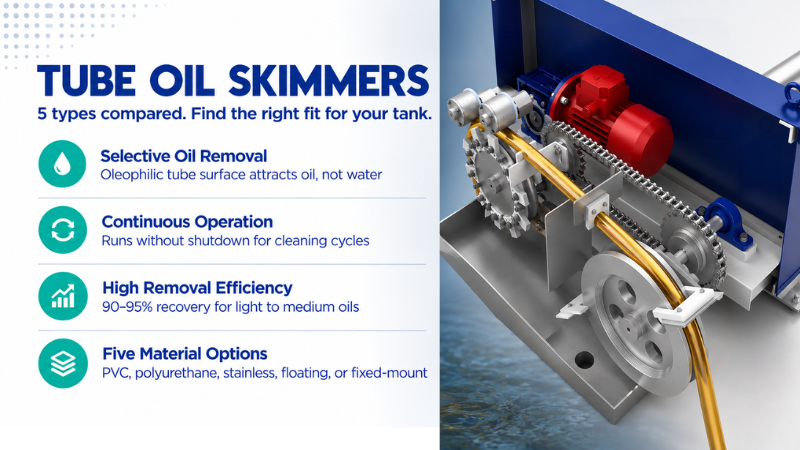
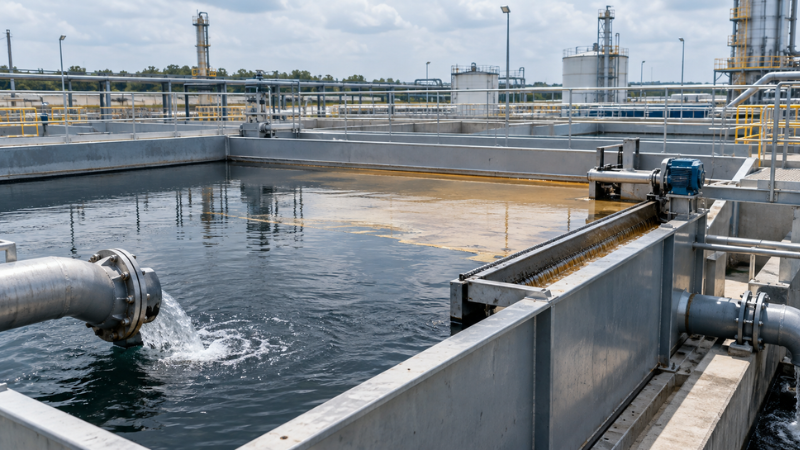
Tube oil skimmers remove floating oil by dragging a closed-loop oleophilic tube across the liquid surface and wiping the collected oil into a trough. The five common types differ in size, mounting, and motor rating. They all collect oil the same way. Because the tube floats, it follows level changes without adjustment. The temperature and chemistry of the liquid decide the tube grade and the frame material. And tank size, access, and hazardous-area rules decide which of the five configurations fits.
How Do Tube Oil Skimmers Collect Surface Oil?
Tube oil skimmers collect oil by adhesion. A drive unit pulls a continuous loop of oleophilic tube out across the tank, and floating oil clings to the outer surface of the tube as it travels.
The loop returns through the drive unit, where guides and wipers strip the oil off the tube. The oil runs into a trough and drains by gravity to a sump or collection tank. The clean tube goes back out for another pass.
Pickup: oil and grease, with very little water Operation: continuous and unattended
Very little water comes up with the oil, so the collection tank holds concentrated oil. That keeps disposal and handling simple.
Because the tube lies on the surface instead of hanging from a fixed point, it rises and falls with the liquid level. A tank whose level swings between shifts or after heavy rain needs no skimmer adjustment. The flexible tube also snakes over, under, and around floating debris that would dam the intake of other skimmer designs.
Manufacturers list a wide range of recoverable materials, from light fuels and lubricating oils to greases, quench oil, and animal and vegetable fats.
What Material Options Suit Different Environments?
Two material decisions matter on a tube oil skimmer. One is the grade of the collector tube. The other is the construction of the skimmer body and its running parts.
Which Collector Tube Grade Should You Choose?
The collector tube is a specially formulated oleophilic polymer, most often polyurethane. Polyurethane resists abrasion, which is why a collector tube can run for long periods with little wear and needs only occasional replacement.
Suppliers typically offer the tube in two grades:
A standard grade for general oily water, coolant, and wash-tank duty
A high-temperature grade for hot or caustic liquids
Tube grade is the first material check on hot process water or a caustic wash tank. Ratings vary by manufacturer, so confirm the rated temperature on the spec sheet against the actual liquid temperature, including upsets.
What Should the Skimmer Body Be Made Of?
The drive unit, frame, and collection pan sit above the liquid, but they still see oil splash, wash solution, and weather. Common construction options include:
Painted or epoxy-coated mild steel for general duty
SS 304 stainless steel where corrosion resistance matters
SS 316 stainless steel as the upgrade for harsher liquids
Ceramic tube guides, which stand up to the constant abrasion of the moving tube
Pulleys follow the same logic. Aluminium, stainless steel, and nylon are all used, and the choice tracks the liquid the tube carries back into the drive.
For a tank with very high or very low pH, stainless construction is the safer specification. The tube grade and the body material should be chosen together, since both see the same liquid.
How Do You Match a Tube Oil Skimmer Type to Your Application?
Tube oil skimmers come in five common configurations. Each suits a different tank size, mounting position, or site classification.
1. Compact Tube Oil Skimmers
Compact tube oil skimmers use a small-diameter tube, around half an inch on standard compact models and smaller still on mini units. They suit parts washers, machining coolant sumps, and small tanks where access is restricted.
Removing tramp oil continuously from coolant and wash tanks extends solution life. The tank is drained and recharged less often.
Best fit: coolant sumps, parts washers, small tanks
2. Large Tube Oil Skimmers
Large tube oil skimmers use a heavier tube, typically around one inch in diameter, that snakes out across the surface and back through the drive. They need a relatively large liquid surface to work properly.
Best fit: basins, large pits, scale pits
3. Floor-Mounted Tube Oil Skimmers
A floor-mounted tube oil skimmer sits on the floor or a platform at the edge of the tank or pit, with the tube running out across the surface. The tube follows the level, so the drive unit can stay fixed in one place.
This is the simplest installation wherever there is room beside the tank.
Best fit: tanks and pits with clear floor space at the edge
4. Cantilever Pole-Mounted Tube Oil Skimmers
On a large tank, the drive unit can be carried on a cantilever pole that reaches out over the liquid. A swing arm on the pole lets the operator bring the skimmer head in for inspection and maintenance without entering the tank area.
Best fit: large tanks, crowded tank edges
5. Flameproof Tube Oil Skimmers
Where the skimmer sits in a hazardous area, such as around hydrocarbon or solvent tanks in oil and gas or chemical plants, the drive needs a flameproof motor. The collection mechanism is identical. Only the motor rating changes.
Confirm the area classification before ordering. It is far cheaper to specify the right motor at the start than to replace one after a site safety audit.
Best fit: classified areas in oil and gas and chemical plants
Which Factor Should Decide First?
Start with the liquid. Its temperature and chemistry set the tube grade and the body material. Then look at the tank: size and access decide between compact and large units, and between floor and pole mounting. Finally, check the area classification.
Water level fluctuation rarely drives the choice. The free-floating tube handles it on every configuration.
Conclusion
Tube oil skimmers recover floating oil by adhesion to a closed-loop oleophilic tube, which is wiped clean at the drive unit and returned to the surface. The tube floats, so tube oil skimmers keep working through level changes and around floating debris without adjustment. Material selection comes down to two choices made together: a standard or high-temperature tube grade, and a skimmer body in coated mild steel, SS 304, or SS 316. The five common types, compact, large, floor-mounted, cantilever pole-mounted, and flameproof, cover tank size, mounting position, and hazardous-area duty. Matching the liquid first, the tank second, and the area classification third leads to the right tube oil skimmer for most industrial applications.
FAQs
Q1. What is a tube oil skimmer used for?
A: A tube oil skimmer removes floating oil, grease, and fats from the surface of water, wastewater, and coolant. A closed-loop oleophilic tube floats across the tank, collects the oil, and returns through a drive unit where wipers remove it.
Q2. Do tube oil skimmers work when the water level changes?
A: Yes. The collector tube floats on the liquid surface, so it rises and falls with the level. No manual adjustment is needed when the level changes between shifts or after rain.
Q3. What are tube oil skimmer tubes made of?
A: Collector tubes are made from a specially formulated oleophilic polymer, most commonly polyurethane. Most suppliers offer a standard grade and a high-temperature grade for hot or caustic liquids.
Q4. Which tube oil skimmer suits a machine coolant tank?
A: A compact tube oil skimmer with a small-diameter tube suits coolant sumps, parts washers, and other small tanks with restricted access. Continuous tramp oil removal extends coolant life and reduces how often the tank is drained.
Q5. When do you need a flameproof tube oil skimmer?
A: A flameproof tube oil skimmer is needed when the drive unit sits in a hazardous area, such as around hydrocarbon or solvent tanks. The collection mechanism is the same as a standard unit; only the motor rating differs.
Q6. Do tube oil skimmers need constant supervision?
A: No. Tube oil skimmers are designed for continuous, unattended operation. The wipers strip oil from the tube automatically on every pass.