A manual bar screen is sized by matching wastewater flow, channel dimensions, debris characteristics, and acceptable cleaning frequency. The right selection balances hydraulic capacity, screening efficiency, maintenance effort, and available installation space.
For plant operators, three factors matter most: the screen must handle the design flow without excessive headloss, the bar spacing must match the debris being removed, and the screen size should support practical manual cleaning. A screen that is too small can restrict flow, while one that is unnecessarily large can increase footprint and maintenance requirements.
What Is a Manual Bar Screen?
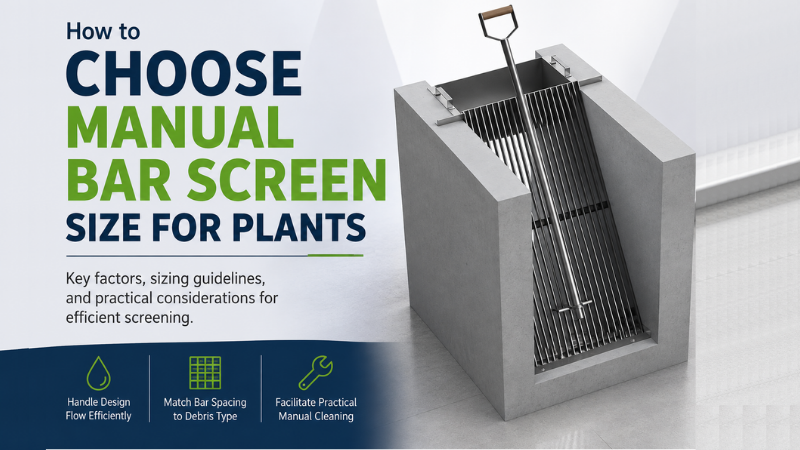
A manual bar screen is a fixed screening device used to remove coarse solids from wastewater before downstream treatment equipment. The screen consists of parallel metal bars arranged at a defined spacing, allowing liquid to pass while retaining larger debris.
Manual bar screens are commonly installed at inlet channels, pumping stations, preliminary treatment stages, and other locations where coarse solids must be removed before reaching pumps or process equipment.
The basic sizing parameters include:
Screen width and height
Clear bar spacing
Bar thickness and profile
Channel width and water depth
Design and peak flow
Expected debris characteristics
Available operating and maintenance space
The screen dimensions should be selected as part of the hydraulic design rather than treated as an isolated equipment choice.
How Does Flow Rate Affect Manual Bar Screen Size?
Flow rate determines how much wastewater must pass through the screen and strongly influences the required submerged screening area. The screen should provide enough open area for the design flow while maintaining acceptable approach velocity and headloss.
Both average and peak flow should be considered during sizing. Designing only for normal flow can result in excessive water level difference across the screen during peak conditions.
How Should Design Flow Be Determined?
The design flow should reflect actual plant operating conditions and the hydraulic role of the screening channel. Useful inputs include average daily flow, maximum hourly flow, pump discharge patterns, storm-related inflows, and expected future capacity requirements.
Where flow varies significantly, the peak condition is particularly important because the screen must continue passing wastewater when the upstream level rises.
A simple screening-area relationship can be expressed as:
Required submerged screening area = Design flow ÷ Allowable velocity
The effective open area is lower than the overall physical screen area because the bars occupy part of the surface. The proportion of open area therefore needs to be considered when establishing the actual screen dimensions.
Why Does Channel Width Matter?
Channel width directly affects the practical width of the manual bar screen. A screen that does not fit the channel properly can create bypass paths, difficult installation conditions, or uneven flow distribution.
The screen should generally cover the effective flow passage so that wastewater cannot easily travel around the sides.
The available channel depth also affects screen height. Sufficient submerged area must remain available under peak-flow conditions while leaving appropriate access for manual removal of accumulated debris.
How Should Bar Spacing Be Selected for Different Debris Types?
Bar spacing defines the size of solids that the screen can retain. Smaller openings capture finer solids but usually collect material more quickly, increasing cleaning requirements and headloss as debris accumulates.
Larger openings reduce the frequency of manual cleaning but allow more solids to pass downstream. The correct spacing therefore depends on the type and size of debris that must be removed.
Typical considerations include:
Coarse plastics, rags, and large floating debris may require relatively large clear openings.
Smaller organic solids and fibrous material may require closer bar spacing.
Applications protecting downstream pumps may prioritize retention of solids that could cause clogging or mechanical damage.
Applications focused only on large debris may use wider spacing to simplify maintenance.
There is no single bar spacing that is suitable for every wastewater application. The selection should be based on the solids profile and the function of the screening stage.
What Happens When Bar Spacing Is Too Small?
Very narrow spacing increases the probability of capturing smaller solids, but the screen can load rapidly when the wastewater contains high concentrations of debris.
As material accumulates, the open flow area decreases. This increases hydraulic resistance and can cause the upstream water level to rise.
For a manually cleaned screen, excessively close spacing can also increase the physical effort and frequency required for raking.
What Happens When Bar Spacing Is Too Large?
Wide spacing allows more wastewater to pass with less resistance when the screen is clean, but larger debris can move downstream.
This can create problems for pumps, valves, channels, and downstream treatment equipment when the retained solids are part of the protection strategy.
The appropriate spacing is therefore a compromise between solids capture, hydraulic performance, and maintenance requirements.
How Does Manual Cleaning Frequency Affect Screen Size?
Manual cleaning frequency is closely related to the amount of debris retained on the screen and the amount of open area available for flow. A screen that accumulates solids rapidly requires more frequent inspection and cleaning.
A larger screening surface can provide additional effective area, but screen size alone does not eliminate the need for routine maintenance. Debris characteristics, seasonal changes, and peak-flow events can all affect cleaning frequency.
Operators should assess how frequently the screen can realistically be inspected and manually raked.
What Is the Trade-Off Between Capacity and Maintenance?
Higher screening capacity generally requires sufficient open area to maintain flow as debris builds up. However, increasing the available screening area can also affect equipment dimensions, installation space, and manual handling requirements.
The practical trade-off can be summarized as follows:
Design priority | Typical consideration |
Higher flow capacity | Increase effective screening area |
Higher debris capture | Reduce clear spacing where appropriate |
Lower cleaning frequency | Provide greater effective open area |
Limited channel width | Optimize screen geometry and orientation |
High debris loading | Allow easier and more frequent manual cleaning |
Downstream equipment protection | Select spacing based on critical solids size |
The best manual bar screen size is not necessarily the largest or smallest available option. It is the size that satisfies hydraulic requirements while keeping routine operation manageable.
How Can Manual Bar Screen Dimensions Be Calculated?
A practical sizing exercise should begin with the design flow, channel geometry, and required clear spacing. The physical dimensions can then be checked against effective open area and expected hydraulic conditions.
A basic workflow is:
Determine average and peak wastewater flow.
Measure the available channel width and operating depth.
Identify the type and approximate size of incoming debris.
Select an appropriate clear bar spacing.
Calculate the required effective screening area.
Check available open area after accounting for bar thickness.
Evaluate expected headloss under clean and partially blinded conditions.
Confirm that operators have adequate access for manual cleaning.
The final dimensions should also account for installation tolerances, structural support, lifting or raking access, and safe operating conditions.
How Should Headloss Be Considered When Choosing a Manual Bar Screen?
Headloss is the difference in water level or pressure caused by resistance as wastewater passes through the screen. A clean screen normally creates less resistance than a screen partially covered by debris.
A manual bar screen should therefore be evaluated under more than one operating condition. Designers and operators should consider clean-screen performance as well as the expected increase in resistance between cleaning cycles.
Why Is Peak Condition Important?
Peak flow and accumulated debris can occur at the same time. If the screen has insufficient effective area during this condition, the upstream water level may rise faster than the downstream system can accept the flow.
The design should therefore provide an operating margin rather than relying only on ideal clean-screen conditions.
This margin becomes particularly important in plants where manual cleaning intervals are long or debris loading varies substantially.
How Do Installation Constraints Influence Manual Bar Screen Size?
Physical installation conditions can limit the practical dimensions of a manual bar screen even when the hydraulic calculation calls for a larger screening area.
The design should account for channel geometry, access platforms, upstream and downstream clearances, lifting arrangements, and the space needed to rake and remove accumulated solids.
Maintenance access is especially important for manual equipment. A screen that is hydraulically suitable but difficult to reach can become inefficient in day-to-day operation.
What Maintenance Access Should Be Provided?
Operators should have sufficient working clearance to inspect the full screening surface and remove accumulated material without excessive bending, reaching, or obstruction.
The layout should also provide a practical location for temporary storage and disposal of screened debris. These details can have a significant effect on actual maintenance performance.
How Should a Manual Bar Screen Be Sized for Different Plant Conditions?
The correct approach changes depending on the wastewater source and operating pattern. Industrial wastewater, municipal sewage, storm-influenced flows, and process effluent can have very different debris characteristics.
A municipal inlet may encounter rags, plastics, and miscellaneous solid waste, while an industrial process stream may contain more predictable or specialized solids. The screen should therefore be selected from actual operating conditions rather than from flow rate alone.
For an existing plant, historical maintenance observations can be valuable. Records of screen cleaning frequency, debris type, upstream water levels, and blockage events can help validate the sizing assumptions.
What Are the Most Common Manual Bar Screen Sizing Mistakes?
Many screening problems result from overlooking one or more operating conditions rather than from errors in the basic dimensions.
Common mistakes include:
Sizing only for average flow instead of peak flow
Selecting bar spacing without assessing debris characteristics
Ignoring bar thickness when calculating effective open area
Providing insufficient access for manual cleaning
Assuming a clean screen represents normal operating conditions
Failing to account for future changes in flow or solids loading
A technically correct calculation can still produce a poor installation when operational and maintenance requirements are not considered.
How Can Plant Operators Verify Whether Screen Sizing Is Appropriate?
Performance can be assessed by monitoring hydraulic behavior and maintenance requirements after installation. Useful observations include upstream water level, frequency of raking, type and volume of retained debris, and any downstream solids that pass the screen.
Persistent high water levels or rapidly increasing headloss may indicate that the screen is undersized, the spacing is too restrictive, or cleaning intervals are too long.
A practical review should compare actual operating conditions against the original design assumptions. This can reveal whether the screening system is performing as intended or whether operating practices need adjustment.
Conclusion
Choosing a manual bar screen requires more than matching the screen width to a channel. Flow rate determines the required effective screening area, while channel geometry determines the practical dimensions available for installation. Bar spacing should reflect the size and type of debris that must be removed, and the expected cleaning frequency should be considered alongside hydraulic capacity. Designers should also account for headloss as debris accumulates, peak-flow conditions, maintenance access, and future operating changes. A properly sized screening system balances solids capture, hydraulic performance, physical fit, and practical manual maintenance rather than optimizing any single parameter in isolation.
FAQs
Q1. What factors determine manual bar screen size?
A: Manual bar screen size is primarily determined by design flow, peak flow, channel width, available water depth, bar spacing, and expected debris loading. Maintenance access and acceptable headloss should also be considered during sizing.
Q2. How is bar spacing selected for a manual bar screen?
A: Bar spacing should be selected according to the type and size of solids that the screening stage needs to retain. Narrower spacing captures smaller debris but can increase headloss and manual cleaning frequency.
Q3. Why is peak flow important when sizing a manual bar screen?
A: Peak flow determines whether enough effective screening area is available during high-flow conditions. A screen sized only for average flow may create excessive upstream water levels when flow and debris loading increase.
Q4. Does a larger manual bar screen require less maintenance?
A: A larger screening area can provide more effective open area and may reduce how quickly flow passages become blocked. However, maintenance frequency also depends on debris quantity, debris characteristics, bar spacing, and operating conditions.
Q5. What is headloss across a manual bar screen?
A: Headloss is the difference in water level or hydraulic pressure caused by resistance as wastewater flows through the screen. Headloss generally increases as debris accumulates and the available open area decreases.
Q6. Can manual bar screen dimensions be selected from channel width alone?
A: No. Channel width is only one sizing parameter; flow rate, water depth, debris characteristics, bar spacing, effective open area, and maintenance requirements must also be evaluated. A screen can fit the channel physically while still being hydraulically undersized.