Oil water separators protect industrial facilities by using gravity and coalescing media to remove free and dispersed oil from wastewater before it reaches drains, storage tanks, or municipal sewer systems. Most units built to the American Petroleum Institute’s design standard remove oil droplets as small as 150 microns, which covers the majority of contaminants found in industrial discharge. Facilities across sectors — from oil and gas to food processing — rely on these systems, and their real-world performance depends heavily on flow rate, retention time, and routine maintenance. Understanding how an oil water separator works, and what conditions affect its efficiency, helps facility managers keep discharge within regulatory limits and equipment running longer.
What Is an API Oil Water Separator?
An API oil water separator is a wastewater treatment unit designed according to American Petroleum Institute guidelines to remove free-floating oil from water using gravity alone.
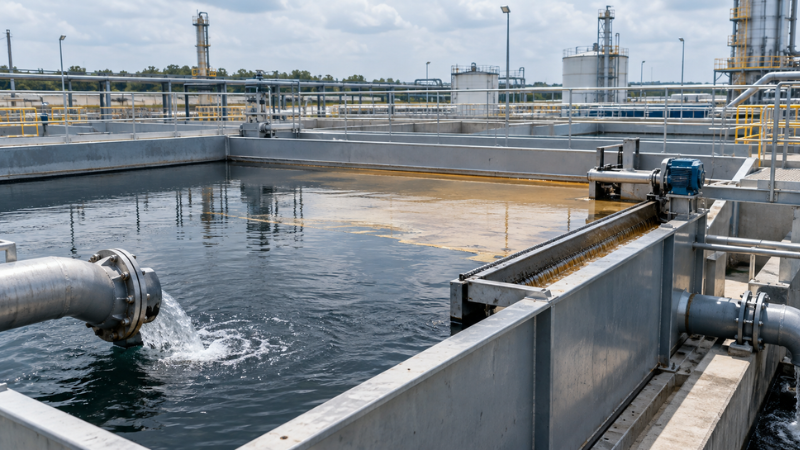
The unit works because oil is less dense than water. Wastewater enters a rectangular tank and slows down enough for oil droplets to rise to the surface while heavier solids settle to the bottom. Water exits from a lower outlet, while a skimmer removes the accumulated oil layer from the top.
This design has been used in refineries, terminals, and manufacturing plants for decades because it requires no chemicals and few moving parts. It works purely on physics, which makes it reliable but also sensitive to the conditions described later in this article.
What Design Standards Govern API Separators?
The core design reference for these units comes from API Publication 421, a guideline originally developed for the petroleum refining industry. It sets rules for sizing a separator based on wastewater flow rate, the target oil droplet diameter, and the specific gravity difference between oil and water.
A common enhancement is the corrugated plate interceptor, often called a CPI separator. It adds a stack of inclined plates inside the tank.
The plates shorten the vertical distance an oil droplet must travel to reach the surface.
They increase the effective separation surface area without increasing the tank’s footprint.
They allow smaller oil droplets to be captured than a basic API design alone.
Because of these plates, a CPI unit can often achieve the same removal performance as a standard API separator in a fraction of the physical space.
How Does Gravity Separation Work in These Systems?
Gravity separation in an oil water separator follows a principle known as Stokes’ Law. This law describes how fast a droplet rises or falls through a fluid based on its size, the density difference between the two liquids, and the viscosity of the water.
Larger oil droplets rise faster than small ones, which is why droplet size is the single biggest factor in separator design.
Minimum removable droplet size: 150 microns (0.15 millimeters)
Droplets below this threshold, particularly emulsified oil, tend to stay suspended in the water column rather than rising to the surface within the tank’s retention time. That’s why gravity separators are typically paired with other treatment steps when emulsified oil is present.
Where Are Oil Water Separators Used Across Industries?
Oil water separators appear in nearly every industry that generates oily wastewater, from heavy manufacturing to vehicle services. Common applications include:
Oil and gas extraction, refining, and pipeline operations
Petrochemical and chemical manufacturing plants
Vehicle maintenance garages and fleet washing stations
Metal fabrication, machining, and stamping facilities
Food and beverage processing plants
Power generation stations
Port and marine terminal operations
In many of these settings, local water authorities set strict limits on the amount of oil and grease allowed in wastewater before it reaches a storm drain or municipal sewer. A vehicle wash facility, for example, typically must pretreat rinse water on-site because it contains motor oil, grease, and road residue that would otherwise violate local discharge limits. Industrial wastewater treatment rules like these are a major reason oil water separators are installed as standard infrastructure rather than optional equipment in these sectors.
What Factors Affect Oil Water Separator Performance?
Several operating conditions determine whether an oil water separator performs close to its design specification or falls short of it.
How Does Oil Droplet Size Affect Separation Efficiency?
Smaller oil droplets rise more slowly through water, giving them less chance of separating out before the water exits the tank. Emulsified oil, generally defined as droplets smaller than 20 microns, is often stabilized by detergents or mechanical agitation and will not separate through gravity settling alone.
Removal efficiency for free oil: often above 90% under proper design conditions
When emulsified oil is a significant part of the waste stream, facilities usually add a pretreatment or polishing step, such as chemical demulsification or dissolved air flotation, ahead of or after the separator.
Why Do Flow Rate and Retention Time Matter?
Retention time is the amount of time wastewater spends inside the separator tank, calculated as the tank’s volume divided by the flow rate. Longer retention time gives oil droplets more opportunity to rise to the surface.
Typical design retention time: 20 to 30 minutes
If flow rate exceeds the unit’s design capacity, even for short periods, retention time drops and untreated oil can pass through with the outgoing water. This is one of the most common causes of an underperforming separator in the field.
What Role Do Temperature and Water Chemistry Play?
Water viscosity increases as temperature drops, and higher viscosity slows the rate at which oil droplets rise. Cold wastewater can noticeably reduce separation efficiency compared to warmer conditions, even in a correctly sized unit.
Surfactants and detergents present another challenge. These chemicals can break oil into smaller emulsified droplets that resist gravity separation, which is why cleaning agents used upstream of a separator need to be selected carefully.
How Does Maintenance Impact Long-Term Performance?
Sludge and floating oil naturally accumulate inside a separator over time, reducing the tank’s usable volume and shortening actual retention time below the design figure. If left unaddressed, this buildup can cause previously separated oil to re-entrain into the outgoing water flow.
Routine maintenance for these systems typically includes:
Skimming the surface oil layer on a set schedule
Removing settled sludge from the tank bottom
Inspecting and cleaning coalescing plates, if present
Checking inlet and outlet flow controls for blockages
Facilities that follow a consistent maintenance schedule are far more likely to keep their oil water separator operating near its original design efficiency for years.
Conclusion
Oil water separators remain one of the most widely used technologies for pretreating industrial wastewater before discharge. Systems built to API design standards rely on the density difference between oil and water, using gravity so oil droplets rise and separate from the water below. Removal performance depends on a handful of measurable factors: oil droplet size, flow rate and retention time, water temperature and chemistry, and how consistently the unit is maintained. Facilities that understand these variables are better positioned to maintain steady removal efficiency, avoid unplanned discharge violations, and get a longer service life from their equipment. As regulatory scrutiny of industrial water discharge continues to grow, a properly designed and well-maintained oil water separator remains a foundational part of responsible wastewater management.
FAQs
Q1: What’s the difference between an API separator and a coalescing plate separator?
A: An API oil water separator uses open gravity settling and typically removes free oil droplets down to about 150 microns. A coalescing plate, or CPI, separator adds inclined plates that shorten the rise distance for oil droplets, allowing it to capture smaller droplets in a more compact tank footprint.
Q2: How often should an oil water separator be cleaned?
A: Cleaning frequency depends on flow volume and how much oil and solids the wastewater contains, but many facilities schedule sludge and oil removal every one to three months. Sites with heavier oil loading or high solids content often need more frequent servicing to protect the unit’s design retention time.
Q3: What is the maximum oil droplet size an API separator can remove?
A: A standard oil water separator built to API guidelines is usually sized to remove free oil droplets 150 microns in diameter or larger. Droplets smaller than this, especially emulsified oil under 20 microns, generally need an additional treatment step such as dissolved air flotation or chemical demulsification.
Q4: Can an API oil water separator remove emulsified oil?
A: Standard gravity-based oil water separators are not effective at removing emulsified oil because the droplets are too small and chemically stabilized to rise on their own. Facilities dealing with emulsified oil typically add a secondary treatment step, such as a demulsifying agent or flotation system, before or after the separator.
Q5: What industries are commonly required to use oil water separators?
A: Requirements vary by jurisdiction, but industries such as oil and gas, vehicle maintenance, metal fabrication, and food processing are commonly required to pretreat oily wastewater before it reaches a storm drain or municipal sewer. Local water authorities usually set discharge limits for oil and grease that determine whether an oil water separator is required on-site.
Q6: How long does wastewater typically stay inside an oil water separator?
A: Retention time varies by design, but many industrial oil water separators are engineered to hold wastewater for roughly 20 to 30 minutes so oil droplets have time to rise and separate. Retention time that’s too short, often caused by flow rates exceeding the unit’s design capacity, lowers separation efficiency and can let oil pass through untreated.