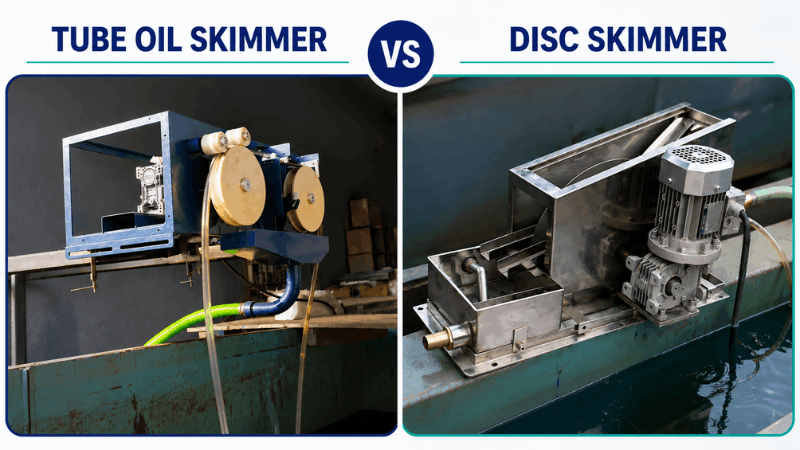
A tube oil skimmer removes floating oil with a continuous oleophilic tube, while a disc skimmer uses a rotating disc; the main difference is how each handles oil layer thickness, space, and maintenance. In simple terms, tube systems are better for hard-to-reach tanks and pits, disc systems are better for compact setups with steady liquid levels, and both are strongly affected by oil viscosity.
Oil skimmers are mechanical devices that rely on surface tension, specific gravity, and a moving medium to remove floating oil from water. That means the best choice is rarely about “which skimmer is better” and more about “which skimmer fits the oil, the tank, and the operating conditions.”
What is a tube oil skimmer, and how does it work?
A tube oil skimmer uses a closed-loop, oleophilic tube that travels across the water surface and attracts floating oil. A wiper or scraper then removes the collected oil from the tube so the oil can drain into a collection point or sump.
This design is especially useful where access is limited, the oil collects in a pit or tank corner, or the surface area is irregular. Tube systems are commonly described as practical for wastewater tanks, equalization tanks, separators, settling ponds, and other tight industrial spaces.
What is a disc skimmer, and how does it work?
A disc skimmer uses a rotating oleophilic disc that dips into the oil layer, picks up oil on the disc surface, and then scrapes the oil off with a stationary wiper. The disc design is compact and is widely used where the oil layer is thin and the liquid level stays fairly steady.
Disc skimmers are often chosen for small wastewater systems, coolant tanks, and parts washers because they are simple, space-saving, and easy to install. Published guidance also notes that disc skimmers work best with lighter oils in the medium-viscosity range, not heavy emulsified oil.
What are the 7 key differences between a tube oil skimmer and a disc skimmer?
The real differences show up in oil behavior, space, maintenance, and where each skimmer performs best. These differences matter because recovery rate is not a fixed number; it changes with oil viscosity, temperature, and the amount of free oil on the surface.
1. How does the collection medium differ?
A tube oil skimmer uses a flexible continuous tube, while a disc skimmer uses a rigid rotating disc. That difference changes how much surface each device can contact at once and how easily each unit can reach awkward oil pockets.
The tube format is better at following uneven routes and reaching narrow or obstructed areas. The disc format is better at offering a controlled pickup zone in a compact footprint.
2. How does oil viscosity affect performance?
Oil viscosity is one of the biggest performance variables for any oil skimmer. Recovery rates are commonly reported using a standard oil because real-world performance changes when the oil gets thinner, thicker, hotter, or colder.
Disc skimmers are typically strongest with light to medium viscosity oils and can struggle when oil becomes emulsified or too heavy. Industry guidance from spill-response literature also places many oleophilic skimmers in the medium-viscosity range, with high selectivity in calm conditions.
Tube oil skimmer performance also depends on viscosity, but tube systems are often chosen when the oil layer is not perfectly uniform or when the oil sits in hard-to-reach places. In practice, that makes the tube oil skimmer feel more forgiving in messy tank layouts, even though viscosity still matters.
3. How do recovery rates differ?
Recovery rate depends on oil type, oil thickness, operating speed, and surface conditions. Skimmer selection guides usually describe recovery capacity in gallons per hour or similar flow-based measures, and those values change with viscosity and site conditions.
Disc skimmers are often selected for precise removal in smaller systems, but they are not usually the highest-capacity option. Tube oil skimmer systems are often used for moderate recovery in tanks and pits where continuous pickup matters more than raw peak capacity.
Removal efficiency:
Disc skimmers usually perform best on thin, stable surface films.
Tube oil skimmer systems usually perform best where oil gathers in confined or uneven zones.
Neither design performs well if the oil is highly emulsified or the surface is too disturbed.
4. What installation space does each skimmer need?
Disc skimmers generally need less structural complexity and are often described as compact and easy to install on tanks with steady levels. That makes the disc design a strong fit for smaller equipment footprints.
A tube oil skimmer usually needs more routing flexibility because the tube must be positioned to sweep the oil surface. That extra flexibility is useful in pits, separators, and tanks with limited access, but it can also mean more attention during setup.
5. How much maintenance does each skimmer need?
Disc skimmers are commonly described as simple, compact, and low-maintenance because the working geometry is straightforward: one disc, one drive, and one wiper zone. That simplicity is a big reason disc units are popular in smaller industrial systems.
A tube oil skimmer also has a fairly simple operating principle, but maintenance usually centers on the tube, the wiper, and the guide path because those are the parts in contact with the oil pickup loop. In other words, the tube oil skimmer trades a bit of simplicity for more reach and flexibility.
6. Which industrial use cases fit each type?
Disc skimmers are a natural fit for small wastewater systems, coolant tanks, parts washers, and other places where the liquid level stays fairly steady. They are also used where a compact, economical solution is needed for light oil contamination.
Tube oil skimmer units are better suited to wastewater equalization tanks, oil-water separators, settling ponds, scale pits, and similar systems where access is tight or the oil collects away from the easiest entry point. That is why the tube oil skimmer often shows up in plants that need surface cleanup in awkward geometry rather than a neat rectangular tank.
Common fit check:
Use a disc skimmer for compact tanks with stable levels.
Use a tube oil skimmer for pits, corners, and hard-to-reach surfaces.
Use a disc skimmer for thin, light oil films.
Use a tube oil skimmer when the oil layer is spread out or access is constrained.
7. Which skimmer handles operating conditions better?
Disc skimmers generally prefer a steady fluid level because their pickup zone depends on consistent immersion depth. If the tank level swings a lot, disc performance can become less predictable.
A tube oil skimmer is usually more adaptable when the oil surface is awkward, the access opening is small, or obstacles sit near the slick. That makes the tube design more flexible in real plant conditions, especially where the oil is not sitting neatly in one open zone.
How should a plant choose between a tube and disc skimmer?
The best choice starts with the oil itself. If the oil is light to medium viscosity and the tank is compact with stable levels, a disc skimmer is usually the cleaner fit. If the oil sits in a pit, corner, separator, or difficult access zone, a tube oil skimmer usually makes more sense.
The next filter is operating consistency. A disc skimmer tends to be easier to standardize in small, predictable systems, while a tube oil skimmer is often better when the facility needs flexibility more than a rigid pickup geometry. In oil-water separation systems, this choice can directly affect downstream load on the treatment process. [Insert link for oil-water separator]
A practical way to decide is to ask four questions:
Is the oil layer thin, medium, or heavy?
Is the tank level steady or variable?
Is access open or restricted?
Does the facility need precision pickup or flexible coverage?
Conclusion
A tube oil skimmer and a disc skimmer solve the same basic problem, but they do it in very different ways. A disc skimmer is compact, simple, and effective for stable tanks with light to medium oil films. A tube oil skimmer is better when access is tight, the surface is uneven, or the oil collects in pits and corners. Recovery rate depends on oil viscosity, surface conditions, and setup quality, so the best choice is always application-specific. For plant owners, the smartest comparison is not about brand or size; it is about matching skimmer geometry to operating reality, especially in [Insert link for industrial wastewater] and [Insert link for wastewater treatment] systems.
Frequently Asked Questions (FAQs)
Q1. What is the main difference between a tube oil skimmer and a disc skimmer?
A: The main difference is the collection medium. A tube oil skimmer uses a continuous oleophilic tube, while a disc skimmer uses a rotating disc to collect floating oil. The best choice depends on tank access, oil viscosity, and how steady the liquid level is.
Q2. Which skimmer works better for light oil?
A: A disc skimmer is usually a stronger choice for light to medium viscosity oil in small, steady tanks. A tube oil skimmer can still work well, but disc systems are often the more compact fit when the surface film is thin and the layout is simple.
Q3. Is a tube oil skimmer easier to install?
A: A tube oil skimmer is often easier to adapt to awkward spaces because the tube can be routed around obstacles. A disc skimmer is usually simpler in a standard tank with a fixed liquid level, so installation can be quicker in those conditions.
Q4. Do disc skimmers need less maintenance?
A: Usually, yes. Disc skimmers are mechanically simple, and that compact design often translates into lower routine maintenance. A tube oil skimmer still has straightforward upkeep, but the tube and wiper path need regular inspection because those parts do the collection work.
Q5. Can both skimmers be used in wastewater treatment?
A: Yes, both are used in wastewater treatment, but in different tank conditions. A disc skimmer is commonly used in smaller, steady systems, while a tube oil skimmer is often better for separators, pits, and hard-to-reach collection zones.