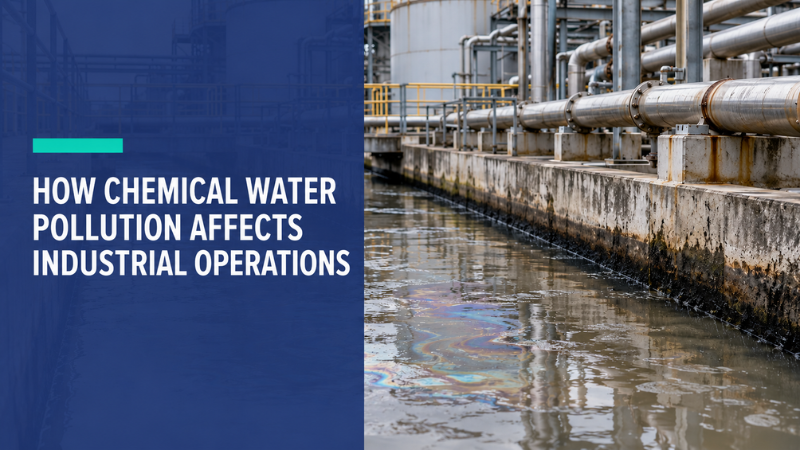
Chemical water pollution affects industrial operations by corroding and fouling plant equipment, putting discharge consents at risk, and leaving contamination that outlasts the process that caused it. The contaminants responsible are well known, and most of them carry numeric discharge limits.
The damage starts inside the plant, long before effluent reaches the outfall. Chlorides crack stainless steel, sulphides turn into acid on concrete, and oil coats every surface it touches. And some of the contaminants involved don’t break down at all. They settle into sediment and stay there, which turns a discharge problem into a long-term liability for the site.
This article covers the contaminants that matter most, what they do to equipment, what happens after discharge, and what the standards actually require.
What are the most common industrial chemical contaminants?
Industrial chemical contaminants fall into a handful of groups, and each group tends to come from a recognisable set of processes. Knowing which group a plant generates is the first step in knowing which limits apply and which equipment is at risk.
The groups that show up most often in industrial effluent are:
Heavy metals such as chromium, lead, mercury, cadmium, nickel, and zinc, typical of plating, metal finishing, and steel processing
Oils, greases, and hydrocarbons from lubricants, machining coolants, fuel handling, and refining
Phenols and cyanides from coking, refining, and electroplating
Aromatic and chlorinated solvents such as benzene, toluene, and trichloroethylene
Acids and alkalis that push effluent outside its permitted pH band
Sulphides from refining, tanning, and anaerobic zones in sumps and sewers
Why do regulators name specific contaminants?
Regulators name specific contaminants because these chemicals are toxic, persistent, or both, at low concentrations. The US Environmental Protection Agency maintains a list of priority pollutants under the Clean Water Act.
US EPA priority pollutants: 126
That list includes every metal above, along with cyanide, phenol, benzene, toluene, and trichloroethylene. India’s general discharge standards set numeric limits for the same substances. So a plant’s chemical profile is never a private matter. It maps directly onto a regulated list.
How does chemical water pollution damage equipment and machinery?
Chemical water pollution damages equipment through two slow mechanisms: corrosion, which removes metal and concrete, and fouling, which coats surfaces and blocks flow. Neither usually trips an alarm. Both show up first in maintenance budgets.
How do chlorides affect stainless steel?
Chlorides cause stress corrosion cracking in austenitic stainless steels such as 304 and 316. The Specialty Steel Industry of North America notes that cracking is rare below a temperature threshold when the steel is fully immersed.
Chloride stress corrosion cracking threshold (full immersion): approximately 60 °C (150 °F)
That threshold is less reassuring than it looks. Under evaporative conditions, where chloride-bearing water wets a surface and dries repeatedly, stainless steel can crack at temperatures well below it. Splash zones, tank walls at the waterline, and the outside of insulated pipework are exactly where those conditions occur. A cracked heat exchanger tube or a weeping weld seam is often the first visible sign of a chloride problem that has been present for years.
Why do sulphides attack concrete?
Sulphides attack concrete through a process called biogenic sulphide corrosion. Hydrogen sulphide escapes from effluent into the air space of sumps, channels, and sewers. Bacteria on the moist concrete above the waterline oxidise it to sulphuric acid, which dissolves the cement binder.
The damage is concentrated in the crown and upper walls, the parts least visible during routine inspection. By the time reinforcement is exposed, the structure needs repair rather than maintenance.
How do oil and grease foul plant equipment?
Oil and grease foul equipment by coating it. A film of oil on a heat-transfer surface cuts heat-exchanger performance. Oil on a level sensor gives a false reading. Grease builds up in pump intakes, wet wells, and screens until flow is restricted.
Pumps make the problem worse. A centrifugal pump shears free oil into small droplets, and those droplets form an emulsion that is far harder to separate than the floating oil it started as. For oily streams, the location of separation matters as much as the method. Free oil removed upstream of the first pump is a simpler problem than an emulsion removed at the end of the line.
Can chemical contaminants disrupt a treatment plant?
Yes. Biological treatment depends on a live microbial population, and heavy metals, cyanides, and phenols are toxic to it. A slug of any of these can suppress the biomass in an activated sludge system. BOD and COD removal then drop for days after the slug itself has passed. Oil and grease cause a related problem by coating biological solids and interfering with oxygen transfer.
What are the long-term environmental consequences of chemical water pollution?
The long-term consequences of chemical water pollution come from persistence. Metals don’t degrade. Some organic compounds break down very slowly. Both accumulate in the sediment near a discharge point, and that sediment becomes a durable record of what a site released.
Mercury shows how this plays out. The US EPA describes how microbes in sediment and soil convert deposited mercury into methylmercury. Methylmercury is taken up by aquatic organisms and bioaccumulates up the food web, concentrating in fish tissue. Mercury deposited in the past can also be re-released from soils and sediments, so historic discharges keep causing harm long after they’ve stopped.
For an operator, these consequences come back in concrete forms:
Sediment contamination near an outfall that is attributable to the site
Tighter consent conditions when a receiving water is already loaded
Remediation obligations that outlast the process or the plant itself
Closer regulatory scrutiny of every future consent application
A discharge that met its limits each month can still add up to a problem over decades, if the contaminant accumulates rather than disperses.
What do discharge standards require of industrial operators?
Discharge standards set the maximum concentration of each contaminant that an industrial effluent may contain at the point of discharge. In India, the general standards appear in Schedule VI of the Environment (Protection) Rules, 1986.
Selected limits for discharge to inland surface water under those general standards:
Oil and grease: 10 mg/L max
COD: 250 mg/L max
BOD (3 days at 27 °C): 30 mg/L max
Suspended solids: 100 mg/L max
pH: 5.5 to 9.0
Hexavalent chromium: 0.1 mg/L max
Lead: 0.1 mg/L max
Mercury: 0.01 mg/L max
Industry-specific standards and the conditions in an individual consent to operate can set different limits. The plant’s own consent document is the controlling reference.
What happens when a plant exceeds its limits?
Exceeding a limit turns a chemical problem into an operational one. Section 33A of the Water (Prevention and Control of Pollution) Act, 1974, empowers pollution control boards to issue written directions. These include the closure, prohibition, or regulation of any industry, operation, or process, and the stoppage of electricity or water supply.
That is the real exposure for a plant manager. A sustained exceedance can stop production. So contaminant control belongs in operations planning alongside uptime and maintenance, rather than being handed to the effluent treatment plant as an afterthought.
Conclusion
Chemical water pollution reaches industrial operations through a small number of well-characterised contaminants: heavy metals, oils and greases, phenols and cyanides, solvents, pH extremes, and sulphides. Chlorides crack stainless steel, especially where surfaces wet and dry. Sulphides turn into acid on exposed concrete. Oil fouls heat exchangers, sensors, and pumps, and becomes harder to remove once a pump has emulsified it. Persistent contaminants such as mercury accumulate in sediment and food webs, which turns past discharges into present liabilities. Discharge standards put numbers on all of this, and enforcement powers reach as far as closure. Treating chemical water pollution as an operational risk is the more accurate way to manage it.
FAQs
Q1. What is chemical water pollution in an industrial context?
A: Chemical water pollution in industry is the presence of dissolved or dispersed chemicals in process water or effluent at levels that harm equipment, treatment processes, or receiving waters. The main groups are heavy metals, oils and greases, phenols and cyanides, solvents, acids and alkalis, and sulphides.
Q2. How does chemical water pollution affect industrial equipment?
A: Chemical contaminants damage equipment mainly through corrosion and fouling. Chlorides can cause stress corrosion cracking in stainless steel, hydrogen sulphide can be converted to sulphuric acid on concrete surfaces, and oil and grease coat heat exchangers, sensors, and pump intakes.
Q3. What is the oil and grease discharge limit in India?
A: Under the general standards in Schedule VI of India’s Environment (Protection) Rules, 1986, oil and grease in effluent discharged to inland surface water is limited to 10 mg/L. Industry-specific standards and individual consent conditions can set different limits.
Q4. Why are heavy metals in wastewater a long-term problem?
A: Heavy metals do not degrade, so they accumulate in sediment near the discharge point. Mercury can also be converted by microbes into methylmercury, which bioaccumulates in aquatic food webs and concentrates in fish tissue.
Q5. What can a pollution control board do if a plant exceeds its discharge limits?
A: In India, Section 33A of the Water (Prevention and Control of Pollution) Act, 1974, allows a board to issue directions that include closure, prohibition, or regulation of an industry, operation, or process. Directions can also include stopping the plant’s electricity or water supply.