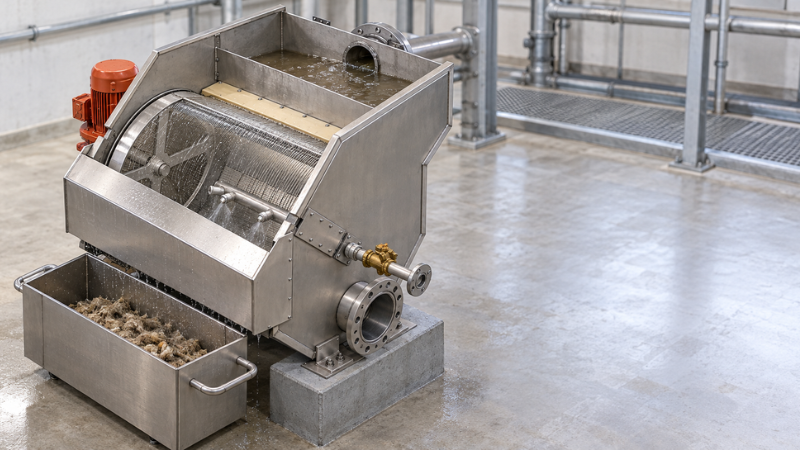
Rotary screens remove suspended solids from industrial and municipal wastewater by passing flow through a slowly turning cylinder of wedge wire or perforated plate that cleans itself as it rotates. Solids larger than the opening stay on the screen and are lifted out of the flow. Screened water carries on to the next stage.
How well that works on a real plant comes down to three decisions. The feed arrangement, inside or outside the drum, decides which duties a rotary screen suits. The aperture sets the trade-off between solids capture and hydraulic capacity. And maintenance, mostly of the spray system and the drive, decides whether rated performance survives the first year of service.
Where a plant has no primary clarification, a fine rotary screen at the headworks carries a large share of the solids-removal load. That makes getting these decisions right a compliance question as much as an equipment one.
How does a rotary screen work?
A rotary screen separates solids from liquid by rotating a cylindrical screening surface through the flow and cleaning it continuously. The drum sits on a horizontal axis and is turned slowly by a geared motor.
Water passes through the drum wall. Anything larger than the opening is held on one face of the drum and carried clear of the liquid as the drum turns.
As captured solids build up, they form a thin mat that traps particles finer than the aperture itself. Capture improves. Head loss rises too, which is why cleaning runs all the time instead of on a timer. A spray bar washes each section of screen from the clean side before that section rotates back into the flow.
The two main configurations differ in which side of the drum the flow enters.
What happens inside an internally fed rotary screen?
An internally fed rotary screen takes influent into the inside of the drum from a headbox at one end. Water flows outward through the screen wall, and solids stay on the inner surface. Internal flights then move the retained solids along the drum to a discharge end.
The screenings never touch the screened water. That clean split is why internally fed units are a common choice where recovered solids have value, or where solids carry-over would cause trouble downstream.
How does an externally fed rotary screen differ?
An externally fed rotary screen reverses the flow path. Influent overflows a weir from a headbox onto the outside of the drum, and water passes inward through the wedge wire slots.
A stationary doctor blade scrapes retained solids off the outer surface. Screened water leaving through the lower part of the drum backwashes the slots on its way out, and an internal spray line clears particles lodged in the wedge wire.
Externally fed rotary screens are widely applied to grease-laden flows and to screening clarifier scum. The open outer face is also easy to inspect, which operators on dirty duties appreciate.
How is the screen opening chosen?
Aperture is the most consequential specification decision on a rotary screen. It sets what the screen captures and how much flow it passes at the available head.
The US EPA’s screening fact sheet (EPA 832-F-03-011, drawing on Crites and Tchobanoglous) classifies rotary drum screens by opening size:
Rotary drum screen, fine-coarse duty: 3–12.5 mm
Rotary drum screen, fine duty: 0.25–3.2 mm
The same fact sheet puts fine-screen performance close to primary sedimentation:
Suspended solids and BOD5 removal, fine screens: 20–35%
Slot width and hole diameter don’t behave the same way at the same nominal size. Wedge wire slots can pass elongated fibres that a round perforation of equal size would catch. So the opening type matters as much as the number on the datasheet.
Going finer than the process needs is a common specification error. Capture barely improves, while blinding, spray-water demand, and head loss all climb.
Where are rotary screens used across industries?
Rotary screens are used wherever a process stream carries particulate that would foul pumps, piping, or downstream treatment, and where floor space is limited. Duties range from protecting a treatment works to recovering product solids.
How do municipal plants use rotary screens?
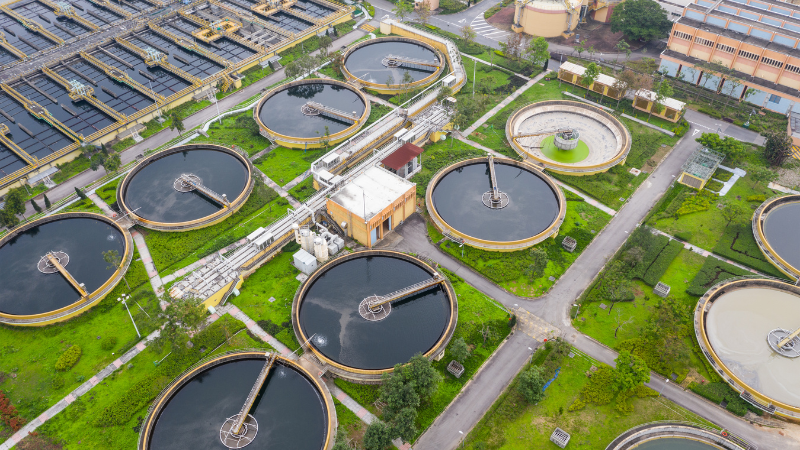
Municipal treatment plants install fine rotary screens at the headworks to remove rags, plastics, and fibrous material before grit removal and biological treatment. The EPA notes that fine screens matter most in plants that lack primary treatment.
Externally fed rotary screens also handle scum skimmed from clarifiers, a sticky, grease-rich load that blinds many other screen types.
How do food and beverage plants use rotary screens?
Meat, poultry, seafood, citrus, and canning operations all run rotary screens on process water and effluent. The duty is often recovery as much as treatment.
In poultry processing, for example, screened solids can go to rendering and screened water can be reused upstream. That reuse only works if fine particles are removed first. Otherwise they plug the spray nozzles the water is meant to feed.
Why do dairy plants specify rotary screens differently?
Dairy wastewater carries milk, whey, and cream residues along with cleaning chemicals. The combination is hard on equipment.
Wetted parts on dairy duty are stainless steel as standard, with grade 316 preferred over 304 where the cleaning regime or the effluent is aggressive. A rotary screen that suits a municipal headworks may corrode early in a dairy.
Which other process industries rely on rotary screens?
Sugar mill processing is one of the long-established rotary screen duties, separating solids from process streams. Chemical and petrochemical plants use rotary screens for wastewater treatment and for product recovery.
In each case the reasoning is the same as in food and dairy. The screen removes the solids that would otherwise load or damage the next piece of equipment. Material selection follows the chemistry of the stream.
How do you keep a rotary screen performing?
Rotary screen maintenance is mostly about keeping the cleaning system and the drive in condition. Loss of capacity on a rotary screen most often starts at the spray bar.
These checks cover the failures that show up most often:
Check the spray pattern weekly. A blocked nozzle leaves an unwashed band on the drum that blinds and cuts hydraulic capacity. Flush the whole spray header after clearing a nozzle.
Track drive motor current. A steady rise usually means the drum is blinding or fouling.
Inspect the drive for grit and rag fouling. The EPA flags drive mechanisms on mechanically cleaned screens for frequent inspection for exactly this reason.
Check doctor blade or brush contact on externally fed units. A worn blade leaves solids on the drum, and those solids return to the flow.
Examine the screening surface for bent wires, deformed perforations, or patches that stay blinded after washing.
Keep the standby screen or bypass channel ready. The EPA treats a standby screen as standard design practice, so the duty rotary screen can be isolated without sending unscreened flow forward.
Why is grease the hardest load for a fine rotary screen?
Grease is the load that historically defeated fine screens. According to the EPA, fine screens were common before 1930 but fell out of use because oil and grease were so difficult to clean from them. They returned in the early 1980s, once better screen materials arrived.
The problem hasn’t gone away. It’s been engineered around. On grease-heavy streams, the usual responses are hot-water flushing and more frequent or higher-pressure backwash. Plants with significant fats, oils, and grease should specify the spray system for that duty from the start, since the spray system is doing most of the work.
Conclusion
Rotary screens earn their place in industrial solids removal through a compact footprint, continuous self-cleaning, and high hydraulic capacity. Internally fed rotary screens keep screenings fully separate from screened water, which suits product recovery. Externally fed rotary screens cope well with grease and scum. Aperture choice sets the balance between capture and capacity, and the EPA’s classification puts fine rotary drum screens at 0.25–3.2 mm openings. Across municipal, food and beverage, dairy, sugar, and chemical duties, the purpose is the same, protecting downstream equipment and treatment. Performance over time depends on maintenance, above all a working spray system, a clean drive, and a standby ready to take the flow.
FAQs
Q1. What is a rotary screen used for?
A: A rotary screen removes suspended solids from wastewater and process water by passing flow through a rotating, self-cleaning cylindrical screen. It protects pumps, piping, and downstream treatment, and in food processing it also recovers solids for reuse or rendering.
Q2. What is the difference between an internally fed and an externally fed rotary screen?
A: An internally fed rotary screen takes flow inside the drum and screens outward, so screenings never contact the screened water. An externally fed rotary screen receives flow on the outside of the drum, and a doctor blade scrapes the retained solids off. Externally fed units are widely used on grease-laden flows and clarifier scum.
Q3. What opening sizes do rotary drum screens use?
A: The US EPA’s screening fact sheet classifies fine rotary drum screens at 0.25–3.2 mm openings and fine-coarse rotary drum screens at 3–12.5 mm. The right rotary screen opening depends on what the downstream process needs protecting from, since a finer aperture blinds faster and raises head loss.
Q4. How much suspended solids can a fine rotary screen remove?
A: According to the US EPA, fine screens remove 20–35% of suspended solids and BOD5, which is comparable to primary sedimentation. Actual removal on a given rotary screen depends on aperture, opening type, and the wastewater being screened.
Q5. Why does a rotary screen blind?
A: Rotary screens usually blind because of grease, fibrous material, or a spray system that has stopped cleaning part of the drum. A single blocked nozzle leaves an unwashed band that loses capacity. Grease blinding is typically handled with hot-water flushing and more frequent or higher-pressure backwash.