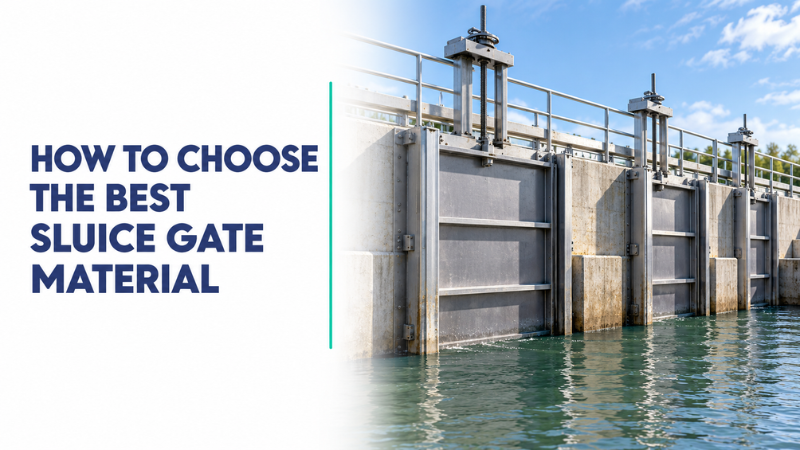
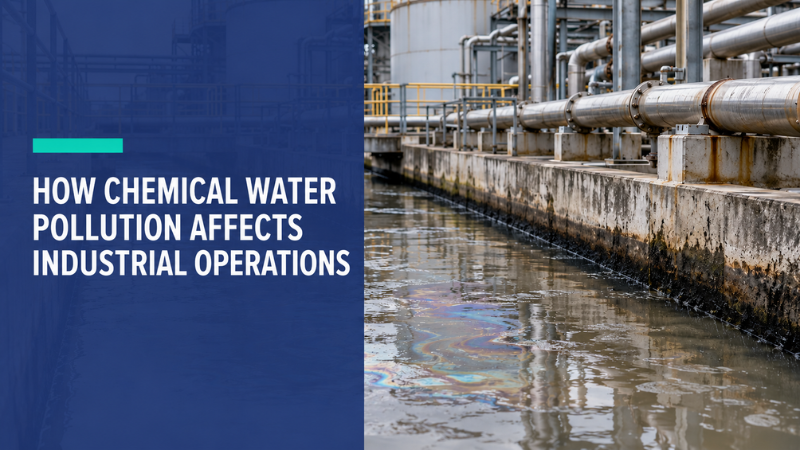
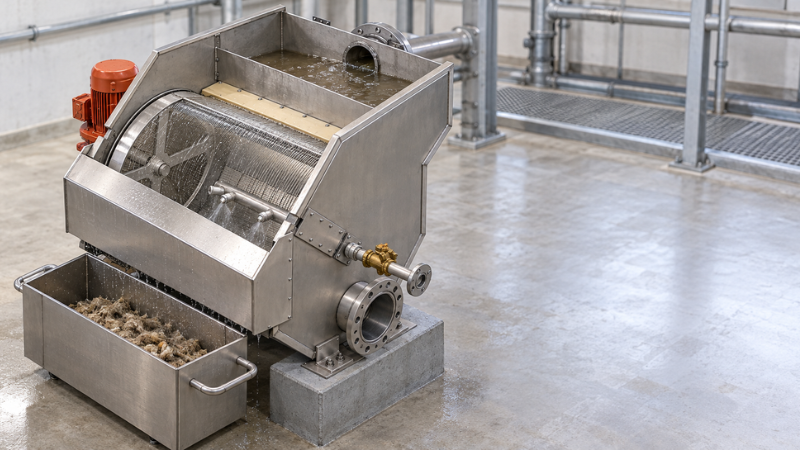
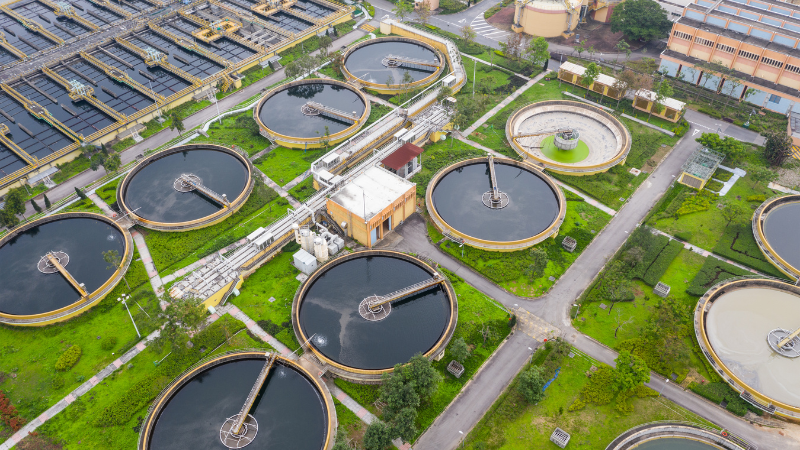
The best sluice gate material is the one that matches the water chemistry at the gate. Cast iron suits clean, low-chloride water, while stainless steel suits corrosive wastewater and saline service.
Three checks settle most decisions. Chloride concentration decides which stainless steel grade will survive, and the gap between grades is wide. Cast iron is usually undone by chemistry, since soft, acidic or sulphide-bearing water attacks the iron and leaves a weakened graphite layer behind. And cost only makes sense measured over the gate’s working life, because replacing an embedded gate means isolating and dewatering the channel.
How do stainless steel and cast iron sluice gates compare on durability?
Cast iron and stainless steel sluice gates are built differently, and that construction shapes how each one wears. The American Water Works Association covers them in separate standards, AWWA C560 for cast iron gates and AWWA C561 for fabricated stainless steel gates. AWWA uses the term slide gate. Both names describe the same equipment.
How is a cast iron sluice gate built?
A cast iron sluice gate has a one-piece cast slide and frame, with reinforcing ribs cast integrally into the slide. Under AWWA C560 the slide and frame may be cast iron or ductile iron, with machined metal seating faces (usually bronze or stainless steel) and adjustable wedges that force the slide onto its seat.
In India, IS 13349 covers cast iron single faced, thimble-mounted sluice gates for water supply and wastewater service.
IS 13349 nominal size range: 300 to 2,500 mm
Typical body material: grey iron to ASTM A126 Class B, or FG 200 to IS 210
Thick casting walls are the durability advantage. Uniform corrosion takes a long time to matter, and in aerated, alkaline water cast iron components have a long record of satisfactory service. The weakness is impact. Grey iron has little ductility, so a slide struck by heavy debris or overloaded by an actuator can crack instead of deforming. Ductile iron, which AWWA C560 permits, reduces that risk.
How is a stainless steel sluice gate built?
A stainless steel sluice gate is fabricated from plate, with welded stiffeners reinforcing the slide. AWWA C561 gates seal against ultra-high-molecular-weight polyethylene (UHMW-PE) seating faces, sometimes paired with resilient rubber seals, in place of machined metal wedges. Specifications commonly call for plate to ASTM A240 in Type 304L or 316L, with Type 304 or 316 stems.
Seating is where the two designs differ most in service. Metal-to-metal wedge seating needs periodic adjustment as the faces wear. Stainless steel gate specifications often require UHMW-PE seals that can be replaced and adjusted without removing the gate from the wall.
The comparison below summarises the two constructions.
Factor | Cast iron sluice gate (AWWA C560 / IS 13349) | Stainless steel sluice gate (AWWA C561) |
Construction | One-piece casting with integral ribs | Fabricated plate with welded stiffeners |
Seating | Machined bronze or stainless steel faces, adjustable wedges | UHMW-PE faces, optional rubber seals |
Main durability risk | Brittle fracture; graphitic corrosion | Pitting and crevice corrosion in chlorides |
Best fit | Clean, aerated, low-chloride water | Corrosive wastewater and saline water |
Which sluice gate material resists corrosion best in industrial wastewater?
In industrial wastewater, chloride concentration and sulphide content decide which sluice gate material lasts. Stainless steel is limited by chlorides. Cast iron is limited by soft, acidic or septic water.
How much chloride can each stainless steel grade handle?
Chlorides break down the passive film on stainless steel at local points, which starts pitting and crevice corrosion. Molybdenum strengthens that film, which is why Type 316 outperforms Type 304. The pitting resistance equivalent number (PREN = %Cr + 3.3 × %Mo + 16 × %N) gives a relative measure.
PREN, Type 304: 19.0
PREN, Type 316 / 316L: 24.2
Stainless steel producers publish approximate chloride limits for pitting and crevice resistance in water:
Type 304: up to about 100 ppm chloride
Type 316: up to about 2,000 ppm chloride
Seawater: about 19,000 ppm chloride, where Type 316 is not recommended
Temperature lowers those limits. At 300 ppm chloride, Type 304 can begin to pit at about 40°C, so warm process effluent needs a more conservative grade than cold storm water.
Specify the low-carbon L grades for any welded gate. A fabricated slide is a welded assembly, and the low carbon content of 304L and 316L protects welds and heat-affected zones from intergranular corrosion.
When does cast iron corrode in wastewater?
Cast iron degrades mainly through graphitisation, also called graphitic corrosion. The iron matrix dissolves and leaves a weak layer of graphite and iron oxide that can still look intact. Unalloyed cast iron is prone to it in soft or mildly acidic water, and hydrogen sulphide at levels as low as about 1 ppm encourages it.
Research on sewage environments has found that cast iron corrosion rates vary with septicity, flow conditions and biological activity. So a cast iron sluice gate on a septic sewer inlet faces far harsher duty than the same gate on a clean-water intake.
What about chemical effluent?
Chemical effluent needs a full analysis before any material is chosen. Type 316 resists sulphuric acid at up to 5% concentration at temperatures up to 49°C. But molybdenum-bearing grades are less resistant to highly oxidising acids such as nitric acid. Select a gate against the worst stream it will see.
AWWA C561 also asks the purchaser to define conditions outside its scope, including grit or sediment exposure, throttling service and how often the gate will operate. Those same facts belong in the material decision.
How should you judge sluice gate cost-effectiveness in marine and chemical industries?
Cost-effectiveness for a sluice gate is the purchase price plus every intervention over its life. In marine and chemical service, corrosion drives most of those interventions.
What changes in marine and seawater service?
Seawater carries about 19,000 ppm chloride, nearly ten times the guidance limit for Type 316. For a gate permanently submerged in seawater, 304L is the wrong choice and 316L is a gamble. Duplex stainless steels such as 2205 give greater resistance to chloride pitting and stress corrosion cracking, and they are the usual step up.
PREN, duplex 2205: about 35
Cast iron can serve in seawater, but only behind protection. Submerged cast iron components are usually sealed with organic coatings or protected with sacrificial anodes, and neither method guarantees complete long-term protection. A coated cast iron gate costs less to buy and carries a coating maintenance liability for its whole life.
What changes in chemical plant service?
In chemical plants the effluent sets the economics. A grade upgrade is paid for once. A gate that pits through its slide costs a shutdown, channel isolation, dewatering and a replacement installed in a wet and possibly hazardous location.
Which cost factors belong in the comparison?
A fair cost comparison between sluice gate materials should include these items:
Purchase price of the gate, frame, stem and actuator
Expected service life in the measured water chemistry
Seat and seal maintenance, including whether seals can be replaced in place
Coating renewal for cast iron or carbon steel components
Access cost for replacement, including channel isolation and dewatering
Stem and fastener compatibility with the gate body
For clean, low-chloride water, a cast iron sluice gate remains cost-effective and well proven. Once chlorides, sulphides or aggressive chemicals enter the picture, stainless steel generally comes out ahead over the gate’s life.
How do you choose the right sluice gate material for your site?
Choosing a sluice gate material comes down to a short sequence of checks on the water and the duty. Work through them in order:
Measure chloride concentration and temperature at the gate location.
Check for sulphides, septic conditions and low pH.
Identify any oxidising acids or solvents in the effluent.
Define grit exposure, throttling duty and operating frequency.
Match the material: cast or ductile iron for clean low-chloride water, 304L below about 100 ppm chloride, 316L up to about 2,000 ppm, duplex for seawater.
Specify L grades for welded parts, with compatible stem and fastener materials.
Conclusion
Choosing the best sluice gate material starts with a water analysis. Cast iron gates built to AWWA C560 or IS 13349 remain a sound choice for clean, aerated, low-chloride service, provided impact loads and graphitic corrosion are managed. Stainless steel gates built to AWWA C561 suit corrosive wastewater, and the grade must follow the chloride level: 304L to about 100 ppm, 316L to about 2,000 ppm, and duplex for seawater. Sulphides and soft or acidic water shorten cast iron life, while heat lowers the chloride tolerance of every stainless grade. In marine and chemical service, judge sluice gate cost over the full working life, including coatings, seal maintenance and the cost of isolating a channel to replace the gate.
FAQs
Q1. What is the best material for a sluice gate in industrial wastewater?
A: Stainless steel is the usual choice for industrial wastewater because it does not suffer the graphitic corrosion that soft, acidic or sulphide-bearing water causes in cast iron. The grade should follow the chloride level, with Type 304L suited to about 100 ppm chloride and Type 316L to about 2,000 ppm.
Q2. Is a cast iron sluice gate still a good choice?
A: A cast iron sluice gate remains a sound choice for clean, aerated, low-chloride water, where cast iron has a long record of satisfactory service. Ductile iron is the better option where impact from heavy debris or actuator overload is likely, because grey iron has little ductility.
Q3. Can a 316 stainless steel sluice gate be used in seawater?
A: Type 316 is not recommended for permanent seawater immersion. Seawater carries about 19,000 ppm chloride, nearly ten times the roughly 2,000 ppm guidance limit for Type 316, so duplex stainless steels such as 2205 are the usual step up.
Q4. What is the difference between a sluice gate and a slide gate?
A: A sluice gate and a slide gate are the same equipment. AWWA adopted the term slide gate when it replaced its original standard with the C560 to C563 series, which cover cast iron, stainless steel, aluminium and composite gates.
Q5. Why specify 304L or 316L stainless steel for a sluice gate?
A: A fabricated stainless steel sluice gate is a welded assembly, and the low carbon content of 304L and 316L protects welds and heat-affected zones from intergranular corrosion. The L grades match the general corrosion resistance of standard 304 and 316.
Q6. What site data is needed to select a sluice gate material?
A: Selecting a sluice gate material needs the chloride concentration, water temperature, pH, sulphide content and any aggressive chemicals at the gate. Grit exposure, throttling duty, operating frequency and the seating and unseating heads complete the picture.