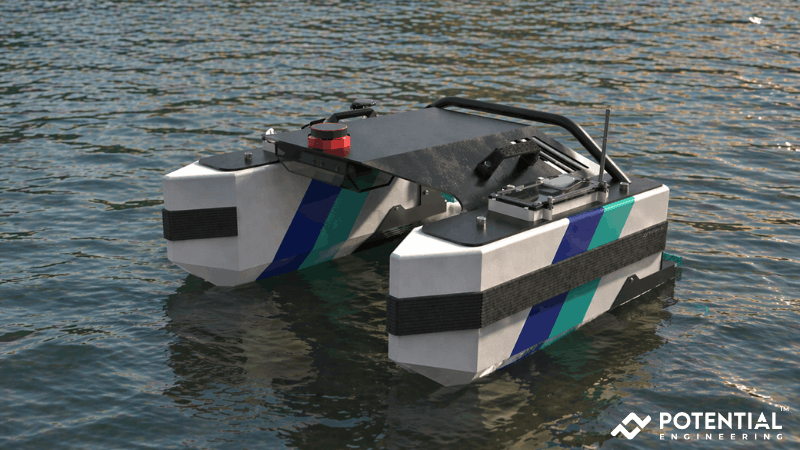
A Floating BOT is an autonomous marine robot designed to operate on the surface of water bodies — capable of both AI-driven autonomous and remote-controlled operation — to perform tasks such as floating waste collection, water quality monitoring, and emergency response on lakes, marinas, and harbours. It combines intelligent navigation with a robust, lightweight build to address water pollution in ways that traditional methods cannot match. Understanding how this technology works, how it collects floating waste from lakes and rivers, and why it matters for water pollution control is essential for anyone engaged in environmental management or urban water governance.
Three things stand out about this technology from the outset. First, Floating BOTs can operate in both autonomous and remote-controlled modes, with AI managing navigation and obstacle avoidance in real time. Second, integrated sensors allow the robot to monitor key water quality parameters during operation, adding an environmental data layer to its cleaning function. Third, its eco-friendly, electric design makes it a sustainable deployment option for sensitive aquatic environments such as marinas, harbours, and lakes.
What Is A Floating BOT And How Does It Work?
This section explains the design, control systems, and operating principles of a Floating BOT — covering what makes it effective on open water surfaces.
The question of what is a floating bot and how does it work is best answered by looking at both its physical construction and its control architecture. A Floating BOT is a surface-level aquatic robot built from durable, corrosion-resistant materials suited to harsh water environments. Its frame uses a combination of Fibre Reinforced Plastic (FRP), Aluminium Alloy 5052 T6, and Ultra-High-Molecular-Weight Polyethylene (UHMWPE) — materials chosen for their strength-to-weight ratio and resistance to water degradation. The Al 5052 T6 designation specifically refers to a heat-treated temper grade, offering enhanced structural strength compared to standard aluminium alloys.
Physical Specifications
The floating bot operates within the following parameters:
Control Modes
The Floating BOT supports multiple control modes, giving operators significant operational flexibility:
Remote Control (Teleoperation): The robot is piloted by a human operator using a wireless controller. This mode is ideal for precise, delicate operations — such as navigating through dense debris fields or executing careful manoeuvres in confined water channels. This is similar in principle to a remote operated vehicle, where a human guides the machine in real time from a safe distance.
Autonomous Navigation with AI: In this mode, the Floating BOT navigates independently using AI-based systems that manage both route planning and real-time obstacle avoidance. The robot detects and steers around obstructions without human input, making it effective in dynamic water environments where surface conditions and debris positions change constantly. This is particularly valuable in crisis situations, where speed of response is critical.
AI-Based Obstacle Avoidance
One of the defining features of the Floating BOT is its use of artificial intelligence for navigation. Rather than following a fixed mechanical path, the robot processes environmental data in real time to identify obstacles and adjust its course accordingly. This capability allows it to operate safely in complex water environments — around moored vessels, near shoreline structures, or through uneven debris fields — without requiring constant human correction.
Water Quality Monitoring
Beyond waste collection, the Floating BOT is equipped with sensors that monitor key water quality parameters during operation. This means every deployment generates not just a cleaning outcome but also environmental data — providing operators and water management authorities with measurable insights into the condition of the water body being serviced. This dual function — cleaning and monitoring — significantly increases the value of each operational run.
Role As A First Responder
Beyond waste collection, the Floating BOT is designed to serve as a reliable aquatic first responder. In flood events, drowning emergencies, or other water-based crises, it can be deployed rapidly — its autonomous mode ensures quick response times while its remote control mode allows precise, controlled operations when human judgement is required. In this context, it also functions as a robotic lifebuoy, capable of reaching distressed individuals in situations where human rescuers face risk.
How Does It Collect Floating Waste From Lakes And Rivers?
This section examines the operational approach of a Floating BOT in water body cleaning — covering how it reaches, intercepts, and manages surface debris.
The core environmental application of a Floating BOT addresses a persistent challenge in water management: how does it collect floating waste from lakes and rivers in a way that is systematic, scalable, and safe? The answer lies in the combination of its AI-driven navigation, thruster-based propulsion, and flexible control modes.
Surface-Level Waste Interception
Water bodies accumulate a range of floating pollutants — plastic packaging, organic debris, foam, surface scum, and other buoyant waste. These materials are typically light enough to rest on the surface but spread widely and unevenly across lakes and water bodies, making manual collection labour-intensive and incomplete.
The Floating BOT operates directly on the water surface, placing it at the exact interface where floating waste accumulates. Its wireless connectivity allows operators to guide it into dense waste zones that would be inaccessible or hazardous for human crews in boats. In autonomous mode, its AI navigation system plots efficient routes through debris fields, adjusting course around obstacles without human input.
AI-Driven Systematic Coverage
One of the most practical features for waste collection is the robot’s AI-based navigation capability. Rather than relying solely on pre-programmed paths or continuous human direction, the Floating BOT can assess its environment in real time and navigate efficiently across a water surface. This allows for systematic coverage of areas where waste is likely to concentrate — near inflows, around edges, or in zones affected by wind-driven accumulation — while dynamically adapting to changing surface conditions.
This adaptive approach contrasts with reactive, manual collection methods, where human operators collect waste only where they can see it in the moment. AI-guided navigation enables planned, repeatable, and verifiable cleaning runs.
Thruster-Based Propulsion
The Floating BOT uses thrusters as its propulsion system. Thrusters provide precise directional control on the water surface, allowing the robot to manoeuvre accurately in tight spaces and respond quickly to navigation commands — whether issued by an AI system or a remote operator. This level of manoeuvrability is particularly important in complex environments such as marinas and harbours, where fixed structures and moored vessels require careful navigation.
Manual Control For Precision Collection
In areas where waste is concentrated and precise manoeuvring is required — such as around aquatic vegetation, near structures, or in narrow channels — the remote control mode allows an operator to guide the Floating BOT with accuracy. This mirrors the control philosophy of a remote operated vehicle in underwater applications: human judgement is brought in precisely where autonomous systems may benefit from situational nuance.
Speed and Manoeuvrability
The robot’s speed of 9.7 km/h allows it to cover significant surface area within a single operational session. Combined with its compact 800 mm × 600 mm footprint, it can navigate areas that larger, crewed vessels cannot access — shallow margins, narrow inlets, and ecologically sensitive zones where disturbance must be minimised.
Why Is A Floating BOT Important For Water Pollution Control?
This section explains the broader significance of Floating BOT technology in the context of water pollution management — covering its environmental, operational, monitoring, and emergency response value.
Why is Floating BOT important for water pollution control? The answer encompasses environmental impact, operational efficiency, real-time water quality intelligence, and the critical need for rapid-response capability in aquatic emergencies.
Addressing The Scale Of Water Pollution
Floating waste is one of the most visible and damaging forms of water pollution. Plastic debris, in particular, fragments into microplastics over time — entering the food chain, degrading water quality, and harming aquatic ecosystems. Surface collection at the floating stage, before fragmentation occurs, is therefore among the most impactful interventions in freshwater pollution control.
The Floating BOT enables this early-stage interception systematically and repeatably. Its AI-based navigation ensures cleaning runs are efficient and comprehensive, reducing the window in which floating waste remains in the water body.
Real-Time Water Quality Intelligence
The integration of water quality monitoring sensors directly into the Floating BOT marks a significant step forward in how aquatic environments are managed. Rather than relying on periodic, manually conducted water tests, operators receive environmental data as a by-product of every cleaning deployment. This continuous stream of information allows water management authorities to track changes in water quality over time, identify pollution events early, and make more informed decisions about intervention frequency and intensity.
Reducing Human Risk In Hazardous Water Environments
Water body cleaning and emergency response operations carry inherent risks for human workers — from unstable water conditions to contaminated water exposure. A Floating BOT reduces the need to place human personnel directly in these environments. Its wireless connectivity allows full operational control from a safe distance on the shore or from a support vessel.
In emergency scenarios, this risk-reduction benefit is even more pronounced. The robot can enter difficult or turbulent water conditions and function as a robotic lifebuoy to support rescue operations where deploying human responders would be hazardous.
Supporting Municipal And Industrial Water Management
Marinas, harbours, and lakes that serve urban populations or support commercial and industrial operations require consistent maintenance to preserve water quality. A floating bot offers water management bodies a deployable, reusable tool that can be integrated into regular maintenance schedules. Its eco-friendly, electric design ensures it can be deployed in environmentally sensitive zones without introducing additional pollution through fuel emissions or noise. The durable material construction — FRP, Al 5052 T6, UHMWPE — is designed for repeated operational cycles in demanding aquatic conditions.
Bridging Environmental And Emergency Response Functions
Unlike specialised tools that serve only one function, the Floating BOT bridges three critical domains: environmental maintenance, water quality monitoring, and emergency response. This multi-purpose design maximises the return on deployment — the same platform used for routine waste collection and water quality sensing can be activated immediately in a flood or drowning emergency without requiring a separate system. For municipalities and water management agencies, this operational versatility represents a significant practical advantage.
Conclusion
The Floating BOT represents a meaningful advancement in how water bodies can be monitored, cleaned, and protected. Its AI-based navigation and obstacle avoidance capability, combined with thruster propulsion and flexible remote or autonomous control, equips operators with the tools to address both routine maintenance and emergency scenarios on a single platform. The addition of integrated water quality monitoring sensors transforms each deployment from a simple cleaning run into a dual-purpose environmental operation. Built from Al 5052 T6, FRP, and UHMWPE, and deployable across marinas, harbours, and lakes, it is engineered for durability and sustainability in demanding aquatic environments. Its role as a robotic lifebuoy and first responder further extends its value, reinforcing why floating bot technology is becoming an important component of integrated water pollution control strategies. As water bodies face increasing pressures from urbanisation, industrial activity, and climate variability, robotic surface platforms of this kind offer a scalable and sustainable path toward cleaner, safer, and better-understood aquatic environments.
Frequently Asked Questions (FAQs)
Q1. What is a Floating BOT and what is it used for?
A: A Floating BOT is an autonomous marine robot that operates on the surface of water bodies using AI-based navigation and remote control. It is primarily used for collecting floating waste and pollutants from lakes, marinas, and harbours, while also monitoring water quality through integrated sensors. Its multi-mode operation makes it suitable for both routine environmental maintenance and aquatic emergency response.
Q2. How does a Floating BOT navigate a water body during cleaning operations?
A: The Floating BOT uses AI-based navigation to autonomously plan routes and avoid obstacles in real time, without requiring constant human input. It can also be operated via remote wireless control for situations that require precise, human-guided manoeuvring. This combination of autonomous intelligence and manual override makes it adaptable to a wide range of water surface conditions.
Q3. What materials is the Floating BOT made from, and why does it matter?
A: The Floating BOT is constructed using Fibre Reinforced Plastic (FRP), Aluminium Alloy 5052 T6, and Ultra-High-Molecular-Weight Polyethylene (UHMWPE). The T6 designation on the aluminium alloy indicates a heat-treated grade, offering enhanced structural strength for sustained aquatic operations. These materials collectively provide the corrosion resistance, low weight, and durability required for repeated deployment in demanding water environments.
Q4. How is a Floating BOT different from a remote operated vehicle (ROV)?
A: A Floating BOT operates on the water surface and is designed for waste collection, water quality monitoring, and emergency response. A remote operated vehicle is typically designed for underwater operation. Both can be guided remotely by a human operator, but the Floating BOT additionally uses AI-based autonomous navigation with obstacle avoidance — a capability not standard in conventional ROV systems.
Q5. Why is collecting floating waste before it sinks important for water quality?
A: Floating waste — particularly plastics — degrades into microplastics when exposed to sunlight and physical forces over time. Once fragmented, these particles are extremely difficult to remove from water and enter aquatic food chains. Surface-level collection by a Floating BOT intercepts this waste at the floating stage, before fragmentation occurs, making it one of the most effective points of intervention in water pollution control.