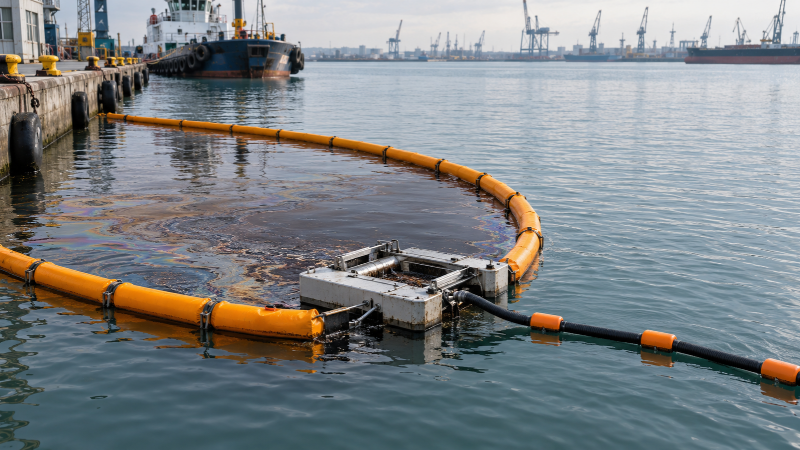
An oil skimmer recovers floating oil from a water surface, either by adhesion to a moving oil-attracting element or by letting oil spill over a weir under gravity. Both depend on the oil separating and rising first.
The principle is the same in a harbour and in a machine coolant sump. What changes is everything around it. Oleophilic designs give the driest recovered oil, but only within a band of oil viscosity. Open water tests a skimmer through waves, currents and spreading oil, while a plant sump tests it through steady contamination and shifting levels. And a skimmer’s nameplate rate is measured in ideal conditions, so real recovery is always lower.
What are the main oil skimming mechanisms?
Every oil skimmer removes oil in one of four ways: adhesion to a moving oleophilic surface, gravity flow over a weir, suction, or physical lifting with belts, scoops or paddles. ITOPF, the international marine oil spill advisory body, groups skimmer designs the same way in its technical guidance.
The mechanism decides which oils a unit handles well, how much water comes up with the oil, and how it copes with debris.
How does an oleophilic oil skimmer work?
An oleophilic skimmer moves an oil-attracting element through the oil layer. Oil wets the element and travels up out of the water with it. A wiper or scraper strips the oil into a trough, and the cleaned element goes back for another pass.
Water doesn’t cling to these materials the way oil does. So oleophilic skimmers usually recover oil with the least free water of any design, a ratio known as recovery efficiency.
The oleophilic element takes several forms, each suited to a different tank or surface:
Belt skimmers hang a continuous oleophilic band vertically into a sump, pit or tank and lift oil from wherever the liquid level sits.
Tube skimmers run a flexible floating tube that loops across the surface and back through a drive unit, where wipers strip the oil off.
Drum skimmers rotate a partly submerged drum, with a blade wiping oil from its face.
Disc skimmers work the same way using a stack of rotating discs.
Rope mop skimmers drag a floating loop of sorbent strands across the surface and squeeze the oil out at a roller.
Grooved discs and drums have been shown to recover more oil than smooth ones. Oleophilic skimmers also perform best within a defined viscosity band.
Effective oil viscosity range (oleophilic designs): 100–2,000 cSt
Below that range, light products such as diesel and kerosene don’t build a film thick enough for high recovery rates. Above it, heavy bunker oil sticks so hard it’s difficult to strip. Water-in-oil emulsions can be almost non-adhesive, so a disc may cut straight through them instead of lifting them.
How does a weir skimmer work?
A weir skimmer uses gravity. Its lip sits at, or just below, the interface between the floating oil and the water, so oil spills over into a collection chamber and is pumped away. Self-levelling designs keep the lip in position as the surface moves.
Weir skimmers handle light to heavy oils. Their weakness is position. If the lip drops below the oil layer, the weir skimmer starts taking in water. No weir skimmer is effective in steep waves, although swell alone doesn’t usually interfere.
Where do suction and mechanical lifting fit?
Suction is the simplest method. A pump or vacuum draws directly from the surface, which works on thick oil but collects a high proportion of water. A small weir fitted to the suction head improves selectivity.
Very viscous oil may not flow to any skimmer at all. Toothed drums, paddle belts and grabs physically pull that oil in.
How does oil skimmer use differ between marine and factory floor applications?
Marine skimming chases oil that spreads, weathers and drifts. Factory floor skimming deals with oil that keeps arriving in a confined, mostly predictable volume. The mechanisms overlap. The failure points don’t.
Condition | Marine: ports, harbours, open water | Factory floor: sumps, pits, tanks |
Where the oil comes from | A spill or release that spreads after the event | Continuous leakage from gearboxes, hydraulics and lubrication |
Water surface | Waves, current and tide | Still or mildly turbulent; level may vary |
Oil layer | Thins and fragments over time | Builds up steadily between removals |
Main limit | Encounter rate and sea state | Reach across the surface and oil type |
Typical mounting | Vessel, boom apex or quayside | Fixed to the tank or sump edge |
What does an oil skimmer face at sea or in port?
At sea, the limit is usually how much oil reaches the skimmer. ITOPF calls this the encounter rate, and it falls as a slick spreads, fragments and weathers. That is the main reason published recovery rates are often unobtainable at a real spill, and ITOPF advises using test results for comparison only.
Wave shape matters more than wave height. Short, choppy waves cost the most oil, while a heavy swell with a long wavelength is rarely a problem. Skimmers rigidly mounted on a vessel can move out of phase with the water and lose effectiveness in higher sea states.
Current is the other constraint, because floating oil escapes from containment booms once the water moves too fast.
Boom containment limit in current: 0.35–0.5 m/s (0.7–1 knot)
In ports and harbours, hulls and pilings get in the way and floating debris collects where the oil does. Rope mop skimmers tolerate debris better than most designs, which is why they suit quaysides and the inside of booms.
What does an oil skimmer face on the factory floor?
On the factory floor, oil arrives steadily rather than all at once. In machining, tramp oil from gearbox leaks and slideway lubrication drains into the coolant sump along with the fluid and floats on top.
That floating layer seals the coolant from the air above it, which favours anaerobic bacteria. Once they take hold, the coolant fouls and gets discarded. Continuous skimming stops the layer forming in the first place.
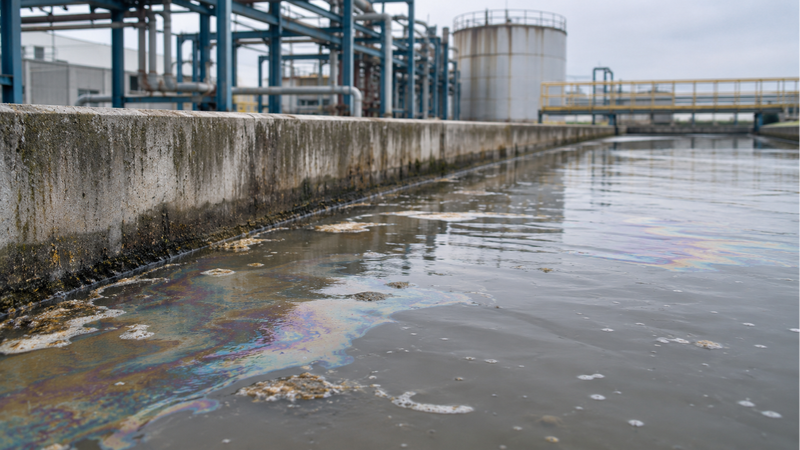
Other plant duties follow the same logic: oil and grease on process wastewater pits, oily water in collection tanks, and hydrocarbon layers on the water bottoms of storage tanks. Oil keeps arriving, so the oil skimmer runs as a fixed installation.
For a tank whose liquid level moves, a fixed-height intake is the wrong choice. A vertical belt or a floating tube follows the level by design, and a floating tube can also reach oil that collects in corners away from the mounting point.
What factors affect oil skimmer performance?
Oil properties, the amount of oil reaching the skimmer, surface conditions, debris and the pump downstream decide what an oil skimmer actually recovers. These are the six to check first.
Oil viscosity and temperature. Viscosity is the primary limitation on most recovery devices. If the ambient temperature drops below the oil’s pour point, the oil turns semi-solid and stops flowing towards the skimmer.
Emulsification. Many oils form water-in-oil emulsions, which can swell the pollutant volume three to four times or more and push viscosity sharply up.
Oil layer thickness. A thin film gives an oleophilic element little to pick up, and a weir lip set into a thin layer draws water.
Surface motion. Short waves, turbulence and level changes all shift the oil–water interface away from where the skimmer expects it.
Debris. Weir and suction heads clog with debris. Rope mops tolerate it.
Pumps and hoses. All pumps lose efficiency as viscosity rises. Positive displacement pumps generally suit recovered oil better, while centrifugal pumps have viscosity limits and tend to promote emulsions.
Emulsified oil viscosity: 100,000 cSt or more
Element condition matters too. Cleaning chemicals can strip the oil-attracting properties from oleophilic discs and sorbent mops, and rubber belts and sorbent materials perish under long exposure to direct sunlight.
Why is nameplate capacity higher than real recovery?
Nameplate capacity is a ceiling. ASTM F2709 measures a stationary skimmer’s recovery rate under ideal conditions, and the standard itself states that this rate is not likely to be achieved at an actual spill. It also sets the nameplate rate of a skimming element and pump combination as whichever of the two is lower.
Regulators build that gap into planning. Under US offshore rules, a skimmer’s effective daily recovery capacity is its rated throughput over 24 hours multiplied by a 20% efficiency factor, to account for daylight, sea state, temperature, viscosity and emulsification.
US regulatory planning factor: 20% of rated throughput over 24 hours (30 CFR 254.44)
Plant duty is gentler than open sea, but the lesson carries over. Size on the oil you actually have, at the temperature it will actually be. A rate measured on test oil in a still tank answers a different question.
Conclusion
An oil skimmer works by adhesion or by gravity, and the right mechanism depends on the oil and the surface. Oleophilic belt, tube, drum and disc designs recover the driest oil and perform best with medium-viscosity oils. Weir skimmers cover a wider viscosity band but need a stable interface. At sea and in port, encounter rate, wave shape and current set the limit. On the factory floor, the skimmer runs as a fixed installation against steady contamination, and tramp oil left in place degrades coolant. In both settings, viscosity, emulsification, debris and pump capacity decide real recovery, and nameplate rates measured in ideal conditions will always overstate it.
FAQs
Q1. What does an oil skimmer do?
A: An oil skimmer removes oil floating on a water surface and transfers it to a collection trough or storage. It works either by adhesion to a moving oil-attracting element or by letting oil flow over a weir under gravity.
Q2. What is the difference between an oleophilic skimmer and a weir skimmer?
A: An oleophilic skimmer lifts oil on a belt, tube, drum, disc or mop that oil sticks to, then wipes it off, so it picks up very little water. A weir skimmer sets a lip at the oil–water interface and lets oil spill over by gravity. Weir designs handle a wider range of oil viscosities but take in water if the lip drops below the oil layer.
Q3. What oil viscosity suits an oleophilic oil skimmer?
A: Oleophilic skimmers are most effective on medium-viscosity oils of roughly 100 to 2,000 centistokes. Light products like diesel don’t form a thick enough film, and very heavy oils are hard to strip from the element.
Q4. Can an oil skimmer work in waves?
A: Short, choppy waves reduce the performance of most oil skimmers, and no weir skimmer is effective in steep waves. A long, slow swell is rarely a problem, and some belt and rope mop designs can operate in choppy water.
Q5. Why does tramp oil shorten coolant life?
A: Tramp oil from gearbox leaks and slideway lubrication floats on a coolant sump and seals the fluid off from the air. That favours anaerobic bacteria, which foul the coolant until it has to be discarded. Removing the floating layer continuously prevents this.
Q6. Why doesn’t an oil skimmer reach its rated capacity?
A: Nameplate capacity is measured under ideal test conditions, such as those defined in ASTM F2709. Real sites have thinner oil, variable viscosity, waves and debris. US offshore planning rules de-rate skimmer throughput to 20% for this reason.