An oil skimmer pulls free-floating oil off a water surface so it can be recovered instead of discharged. The industries that depend on oil skimmers most are steel, marine and ports, power generation, oil and gas, chemical, food and beverage, and municipal wastewater.
Each of these sectors has a tank, sump, pit or basin where oil rises and sits on the surface. What changes from one to the next is the oil, the discharge limit the plant answers to, and the conditions the oil skimmer has to survive.
Three points hold across all seven. Indian discharge standards put a hard number on oil and grease, and some of those numbers are tight. An oil skimmer removes free oil only, so emulsified oil needs a separate step. And the right skimmer type follows from oil viscosity, water temperature and water level more than from the industry label.
What does an oil skimmer do?
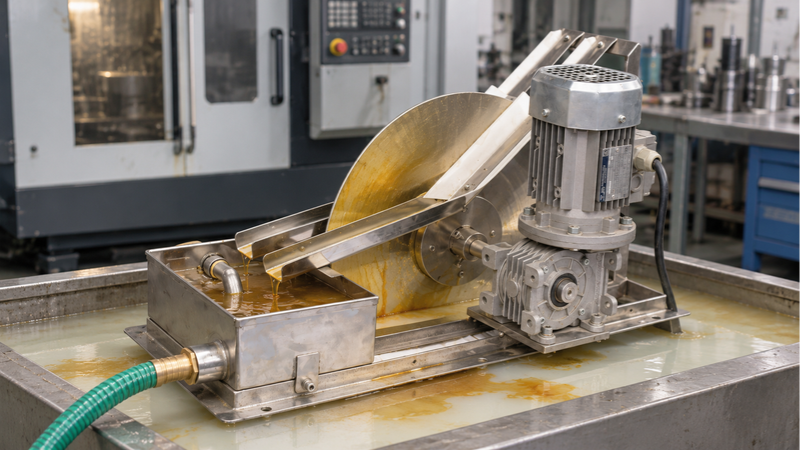
An oil skimmer lifts oil off the water surface using a medium that oil wets more readily than water. That oleophilic medium can be a belt, a tube, a drum or a floating collector.
As the belt, tube or drum passes through the surface layer, oil clings to it. A wiper or scraper strips the oil into a trough, and from there it drains to a collection vessel. Most of the water stays in the tank.
Floating oil skimmers ride the surface and follow the water level. Fixed units work at one height.
One limit shapes every application below. Belt, tube and drum skimmers recover oil that is floating free. Oil that has emulsified into the water stays behind.
1. Why do steel and metal processing plants need oil skimmers?
Steel and metal processing plants use oil skimmers mainly to remove tramp oil from water-based coolants and process water. Tramp oil is the hydraulic oil, way lube and gear oil that leaks out of machines and ends up in the coolant.
On a coolant sump, a layer of tramp oil cuts the coolant off from air. That favors anaerobic bacteria. The rancid smell from a neglected sump, and coolant that has to be dumped early, both trace back to this.
Rolling mill sumps and scale pits add a second problem. Mill scale and fines settle while lubricating oil floats, so the oil skimmer has to keep working over a pit with a heavy solids load.
For coolant recovery, a belt or tube oil skimmer on each sump is routine maintenance. Skipping it shortens coolant life.
2. Why do marine and port operations depend on oil skimmers?
Marine and port operations work under a 15 ppm oil limit. India’s Merchant Shipping rules on oil pollution from ships define filtering equipment as equipment designed to produce effluent with no more than 15 parts per million of oil.
Oil content limit for ship effluent: 15 ppm
The Major Ports (Prevention and Control of Pollution) Rules apply the same figure inside port limits. No vessel may discharge ballast or an oil mixture within a major port if its oil content exceeds 15 ppm.
Oil content limit for ballast or oil mixture within a major port: 15 ppm
The filtering equipment does the 15 ppm job. An oil skimmer works earlier in the chain. Taking free oil off bilge holding tanks and shore-side oily waste tanks keeps the load on the separator down.
Port water adds another condition. Berths, harbor basins and dry docks collect oil from vessel operations, and the water level moves with the tide. A fixed oil skimmer set at one height loses the oil as soon as the level shifts. This is floating oil skimmer territory.
3. How do power generation facilities use oil skimmers?
Power generation facilities collect oil from turbine lube systems, transformer areas, fuel handling and equipment drains. Most of it ends up in drain sumps, oily water pits and ash handling water.
Thermal power plants in India have their own effluent standards under the Environment (Protection) Rules, 1986. Two of the regulated streams carry an oil and grease limit.
Boiler blowdown, oil and grease: 20 mg/L Ash pond effluent, oil and grease: 20 mg/L
Oil at a power station rarely arrives at a steady rate. A transformer drain or a turbine sump can run clean for weeks and then take a slug from a leak. An oil skimmer in the collection pit catches that slug before it moves downstream.
4. What role do oil skimmers play in oil and gas operations?
Oil and gas sites handle more free oil than any other sector here, and refineries answer to some of India’s tightest limits. The standards for the oil refinery industry, notified as G.S.R. 186(E) on 18 March 2008, set these oil and grease limits.
Refinery treated effluent, oil and grease: 5.0 mg/L Once-through seawater cooling effluent, oil and grease: 1.0 mg/L
Oil skimmers sit at hydrocarbon storage tank water draw-offs, separator bays, oily drain sumps and effluent pits. Every liter of free oil recovered at the first pit is a liter the effluent treatment plant never sees. With 5.0 mg/L as the target at the outlet, the first pit is the logical place to start.
5. Where do chemical plants use oil skimmers?
Chemical plants use oil skimmers in equalization tanks, process drain pits and cooling water sumps. Anywhere lubricating oil or a floating organic layer separates from the water is a candidate.
The skimming principle is the same as in any other plant. The specification is where chemical service differs. The belt or tube material, the wiper and every wetted part have to tolerate the stream’s pH, temperature and any dissolved solvents. A medium that degrades in the stream loses its oil pickup.
Specify a chemical-service oil skimmer from the full stream analysis rather than from the oil alone.
6. Why do food and beverage plants need oil skimmers?
Food and beverage plants generate fats, oils and grease (FOG) from frying, meat and poultry processing, dairy lines and equipment washdown.
FOG behaves differently from mineral oil. Animal fats firm up as they cool. An oil skimmer placed far downstream can meet a crust where it expected a liquid layer. Skimming at the first collection pit, while the wastewater is still warm, keeps the fat liquid enough to recover.
Food plants without a sector-specific standard fall under the general discharge standards in Schedule VI of the Environment (Protection) Rules, 1986.
Oil and grease to inland surface water: 10 mg/L Oil and grease to public sewers: 20 mg/L
7. How do municipal treatment plants use oil skimmers?
Municipal treatment plants receive FOG from homes and food outlets, along with hydrocarbons from road runoff and small industrial users. That oil collects in pumping station wet wells, inlet chambers and primary clarifiers.
In a wet well, floating grease builds into a mat that can foul level controls and pumps. An oil skimmer working the wet well surface takes it off before it hardens.
On primary clarifiers, floating scum is usually handled by the scum scraper. So the oil skimmer’s place in a municipal plant is upstream, at the pumping stations and inlet works.
How do you choose the right oil skimmer for your industry?
The right oil skimmer depends on conditions at the tank, sump or pit. The industry is only a starting point. These six checks decide the specification:
1. Oil type and viscosity, from light hydraulic oil to heavy fuel oil or animal fat
2. Water temperature, which affects fat behavior and medium life
3. Water level variation, which decides between a fixed and a floating oil skimmer
4. Oil condition, free-floating or emulsified
5. Solids, scale and debris load at the surface
6. Duty cycle, continuous or intermittent
If most of the oil in a stream is emulsified, an oil skimmer is the wrong first tool. Separate or break the emulsion first, then skim what floats.
Conclusion
An oil skimmer belongs in any plant where free oil floats on water before discharge or reuse. Steel plants use it to keep coolant in service. Marine and port operators use it ahead of filtering equipment that has to meet 15 ppm. Power stations, refineries and chemical plants use it to catch leaks and stay inside Indian oil and grease limits, which run from 20 mg/L for thermal power plant streams down to 5.0 mg/L for refinery effluent. Food and beverage and municipal plants use it to pull FOG out early, while it is still liquid.
Across all seven industries, one rule holds. An oil skimmer removes free oil, so match the skimmer type to the oil, the water temperature and the water level, and deal with emulsified oil separately.
FAQs
Q1. Which industries use oil skimmers the most?
A: The heaviest users of oil skimmers are steel and metal processing, marine and port operations, power generation, oil and gas, chemical, food and beverage, and municipal wastewater. Any facility where free oil floats on water in a tank, sump, pit or basin is a candidate.
Q2. Can an oil skimmer remove emulsified oil?
A: No. Belt, tube and drum oil skimmers recover oil that floats free on the surface, and emulsified oil stays in the water. Emulsified oil has to be separated or broken out first, after which the oil skimmer can recover what rises.
Q3. What oil limit applies to ships and ports in India?
A: India’s Merchant Shipping rules on oil pollution set 15 parts per million as the oil content filtering equipment must achieve. The Major Ports (Prevention and Control of Pollution) Rules bar vessels from discharging ballast or oil mixtures above 15 ppm within a major port.
Q4. What is tramp oil and why should it be skimmed from coolant?
A: Tramp oil is hydraulic, lubricating and way oil that leaks from machines into water-based coolant. Floating on the sump, tramp oil cuts the coolant off from air, encourages anaerobic bacteria and shortens coolant life, so skimming it is routine coolant maintenance.
Q5. What is the oil and grease discharge limit for refineries in India?
A: Under India’s oil refinery standards notified as G.S.R. 186(E) in 2008, treated refinery effluent must not exceed 5.0 mg/L of oil and grease. Effluent from once-through seawater cooling is limited to 1.0 mg/L.
Q6. When should you use a floating oil skimmer instead of a fixed one?
A: Use a floating oil skimmer wherever the water level rises and falls, such as tidal berths, wet wells and collection pits with variable inflow. A fixed oil skimmer suits tanks and sumps where the level stays steady.