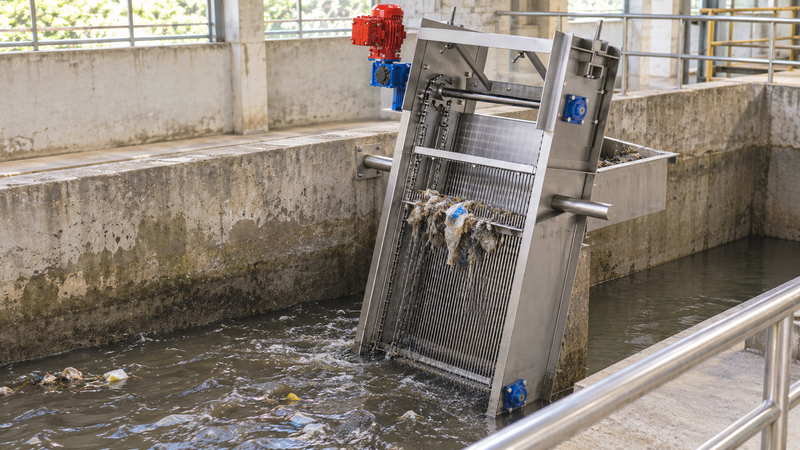
A mechanical bar screen protects downstream treatment equipment by raking rags, plastics and floating debris out of the flow before they reach pumps, meters and grit chambers. In Indian practice, two documents govern how that screen is specified.
IS 6280:1971, the Bureau of Indian Standards specification for sewage screens, covers construction, raking mechanisms and controls. The CPHEEO Manual on Sewerage and Sewage Treatment Systems (2013) sets the design approach most Indian STPs follow today. Read together, they say three things. Bar spacing decides what is stopped. Channel velocity decides whether it stays stopped. And standby screens, bypasses and controls decide whether protection continues when a screen is out of service.
What debris does a mechanical bar screen remove?
A mechanical bar screen removes floating and coarse material such as rags, fibres, plastic sachets, sheet plastic, leaves and wood. The clear spacing between the bars sets the size cut-off.
The CPHEEO Manual names sachets, plastic sheet bits, leaves, fibres and rags as the main material screening must remove. IS 6280 adds pieces of wood and general floating debris. IS 6280 also applies to screens on wholly industrial waste streams, not only domestic and municipal sewage.
How are screens classified by bar spacing?
The CPHEEO Manual recommends three screening stages in sequence. Typical clear openings for each:
Coarse screens: 25 mm, serving mainly as protective devices
Medium screens: 12 mm, mechanically raked, used before all pumps and treatment units
Fine screens: 5 mm, using perforated plate, wire cloth, closely spaced bars, or drum and disc units
IS 6280 uses older, wider classes. Coarse screens are above 50 mm, medium screens 20 to 50 mm, and fine screens below 20 mm. So a 15 mm screen is “fine” under IS 6280 and falls between CPHEEO’s medium and coarse classes. A specification should name the document it follows, or “fine screen” will mean two different things on the same project.
How does bar shape affect capture and headloss?
IS 6280 specifies flats of rectangular or trapezoidal section, at least 10 mm thick and 50 mm deep, with no joints. The CPHEEO Manual describes medium screen bars of about 10 mm × 50 mm, tapering slightly toward the downstream side and set with the longer dimension parallel to the flow.
The taper does real work. A solid that clears the narrow upstream gap keeps moving instead of jamming between the bars, which is the same principle the manual describes for wedge-wire screens.
Bar shape also sets headloss. The CPHEEO Manual gives these Kirschmer bar shape factors for clean-screen headloss, where a lower factor means lower headloss at the same spacing:
Sharp-edged rectangular bar: 2.42
Rectangular bar with semicircular upstream face: 1.83
Circular bar: 1.79
Rectangular bar with both faces semicircular: 1.67
Which raking mechanisms are used?
IS 6280 recognises three raking mechanisms: revolving rakes for curved screens, reciprocating rakes for straight screens, and endless revolving rakes. For straight flats, the screen is inclined 60 to 90 degrees from horizontal.
Rake speed limit: not more than 3 m/min
Two construction details in the standard protect the process directly. A dead plate of mild steel, at least 5 mm thick, stops lifted screenings from dropping back into the flow downstream of the screen. And a mechanical overload device can disengage the rake if it jams on an unusual obstruction.
How does a mechanical bar screen prevent pump damage?
A mechanical bar screen prevents pump damage by stopping rags and fibres before they reach the impeller and the suction pipe.
The CPHEEO Manual is direct about the failure. Unscreened rags and fibres get into pumps and entangle in the impellers. They can also be drawn into suction pipes and choke them, and the blockage is then hard to locate in the pipeline. That is why the manual places screens ahead of pumping stations and flow meters, as the first step in every STP, and calls for medium screens before all pumps. IS 6280 states the same purpose in its foreword: sewage reaching treatment plants and pumping stations should be screened to protect the machinery.
Why does channel velocity matter?
Velocity decides whether a captured rag stays on the bars. Too slow, and solids settle in the channel. Too fast, and pliable material is pushed through the openings toward the pumps. The two documents set these limits:
IS 6280, approach channel: not less than 0.3 m/s at average design flow
IS 6280, through the screen openings: not more than 0.9 m/s at maximum expected flow
CPHEEO, through the open area: 0.6 to 1.2 m/s at peak flow
CPHEEO, approach channel: not less than 0.3 m/s at low flow, and about 0.8 m/s where considerable storm water is handled
The ranges overlap. A screen held between 0.6 and 0.9 m/s through the openings at peak flow satisfies both documents. The CPHEEO Manual also makes a straight approach channel mandatory, at least five times the width of the screen chamber, so that velocity is even across the screen face.
Blinding works against these limits. As debris builds on the bars, open area falls and velocity through the remaining gaps rises, so a screen that rakes too slowly drifts above the limit when the debris load is highest.
Where should the screen sit relative to the pumps and grit chamber?
IS 6280 places screening ahead of the grit chamber. The CPHEEO Manual recommends screens ahead of mechanised grit chambers so that rags do not foul the grit equipment.
Where sewers are deep and grit removal ahead of the pumps is impractical, the manual allows only a bar screen ahead of the pumps, with grit removal after them. In that layout the bar screen is the only protection the pumps have. IS 6280 adds a practical limit: coarse screens may need to go in deep pits ahead of pumps, but medium screens should not, because of the operating and maintenance difficulty.
How does a mechanical bar screen integrate with the treatment plant?
A mechanical bar screen integrates as the first stage of a staged protection sequence. A standby screen, a bypass and controls that respond to debris load keep that protection in place.
What does each screening stage protect?
In the CPHEEO sequence, the coarse screen protects the medium screen, and both protect the fine screen. The manual states that fine screens are not normally suitable for raw sewage directly because of clogging, so they depend on the stages upstream. IS 6280 likewise says mechanically cleaned medium screens should be preceded by a manually cleaned coarse screen, and it recommends mechanical screens above a set flow:
Mechanical screens recommended above: 400 m³/h average sewage flow
Across both documents, screening protects four groups of downstream equipment:
How should standby and bypass be arranged?
IS 6280 requires that wherever a mechanically cleaned screen is used, an auxiliary unit, mechanical or manual, is provided as standby with arrangements to divert the flow. The CPHEEO Manual asks for manual raking provision for when the mechanical rake is out of order, penstocks and bypass arrangements at the screens, and a plant bypass after the screen chamber.
How should the rake be controlled?
The CPHEEO Manual lists the controls a plant with mechanically cleaned screens should have:
Manual start and stop
Automatic start and stop by clock
High-level switch and high-level alarm
Start or overload switch actuated by loss of head
Overload alarm
IS 6280 prefers a time switch for its reliability, backed by an electrode switch that runs the rake continuously at a set high level and raises an alarm. Both documents therefore pair a timer with a level trigger, and the level trigger is what carries the screen through a debris surge. The CPHEEO Manual also notes that intermittently cleaned screens tend to release surges of relatively high flow soon after cleaning. Shorter, more frequent cycles limit those surges.
What happens to the screenings?
Screenings volume climbs steeply as bar spacing narrows. The CPHEEO Manual gives these figures for sanitary sewage:
Screenings at 100 mm clear opening: 0.0015 m³ per million litres
Screenings at 25 mm clear opening: 0.015 m³ per million litres
That is a ten-fold increase, and the handling equipment has to keep pace or the screen backs up. The manual describes screen compactors that dewater and compress screenings, and says screenings should not be left in the open or carried on uncovered conveyors, with conveyors kept as short as possible. Disposal is by burial, composting, or mixing with town refuse as the local Pollution Control Board permits. IS 6280 provides for a belt conveyor where screenings must travel to a distant receptacle.
Conclusion
In Indian practice, a mechanical bar screen is the first protection for pumps, suction pipes, flow meters and grit equipment. The CPHEEO Manual sets a coarse, medium and fine sequence at about 25, 12 and 5 mm, while IS 6280 uses older classes, so every specification should name the document it follows. Velocity through the openings held between 0.6 and 0.9 m/s at peak flow satisfies both documents and keeps captured rags on the bars. Where only a bar screen stands ahead of the pumps, it is their only protection. Both documents require a standby screen with flow diversion, and both pair timer control with a high-level trigger. A mechanical bar screen specified to these points keeps every downstream unit running.
FAQs
Q1. What is a mechanical bar screen?
A: A mechanical bar screen is a row of flats placed across a sewage channel, fitted with a mechanical raking device that lifts captured debris out of the flow. IS 6280 defines the screen and its raking mechanisms, and the CPHEEO Manual places screening as the first step in every STP.
Q2. What bar spacing is used for screens in Indian STPs?
A: The CPHEEO Manual recommends three stages in sequence, with typical clear openings of 25 mm for coarse, 12 mm for medium and 5 mm for fine screens. IS 6280 uses older classes, with coarse above 50 mm, medium 20 to 50 mm and fine below 20 mm, so a specification should state which document it follows.
Q3. How do bar screens stop pumps from clogging?
A: Bar screens stop rags and fibres before they reach the pumps, where the CPHEEO Manual notes they entangle in impellers and can choke suction pipes. For this reason the manual places screens ahead of pumping stations and calls for medium screens before all pumps.
Q4. What velocity should a bar screen channel be designed for?
A: IS 6280 calls for at least 0.3 m/s in the approach channel at average flow and no more than 0.9 m/s through the openings at maximum flow. The CPHEEO Manual gives 0.6 to 1.2 m/s through the open area at peak flow, so a design between 0.6 and 0.9 m/s satisfies both.
Q5. Can a fine screen be used directly on raw sewage?
A: The CPHEEO Manual states that fine screens are not normally suitable for raw sewage directly because of clogging. It recommends coarse and medium screens upstream, so the fine screen only sees material that has already passed the larger openings.
Q6. Is a standby screen required with a mechanical bar screen?
A: Yes. IS 6280 requires an auxiliary screen, mechanically or manually operated, wherever a mechanically cleaned screen is used, with arrangements to divert the flow. The CPHEEO Manual also asks for manual raking provision, penstocks and a bypass at the screens.