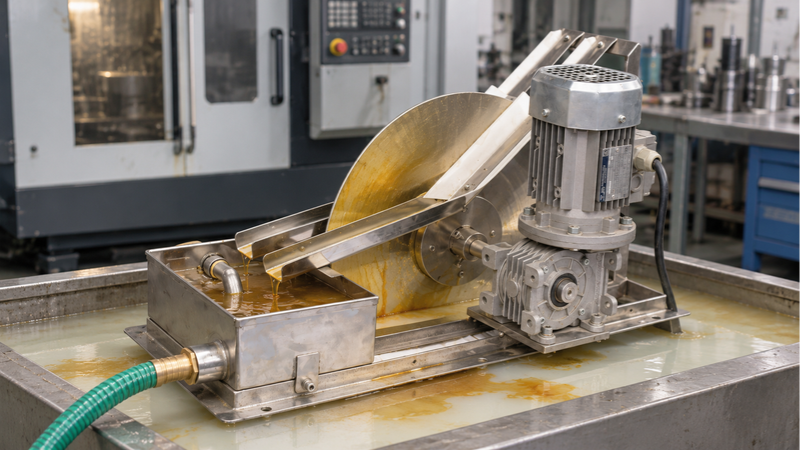
A disc oil skimmer works by turning a partly submerged disc through the liquid surface, so floating oil sticks to the disc and is wiped off into a collection trough. Oil clings to the disc far more readily than water does. That lets the unit lift concentrated oil out of a tank with relatively little water.
Three things decide whether a disc skimmer earns its place in a plant. The liquid level has to stay steady, because only the immersed edge of the disc does any work. The disc material has to suit the fluid’s temperature and chemistry. And the wipers and disc face need routine inspection, since a scored disc drags out more water and a worn wiper leaves oil on the disc.
What is a disc oil skimmer?
A disc oil skimmer is a compact oleophilic skimmer that uses a rotating disc as its pickup medium. It belongs to the same family as belt, tube, drum and mop skimmers, all of which rely on oil adhering to a moving surface.
Two physical properties do the work. Most hydrocarbons have a lower specific gravity than water, so in a quiet tank the oil rises and floats. Oil also bonds to the skimming medium more readily than water does, so the disc carries an oil film out of the tank while most of the water runs back off.
Industrial disc skimmers are usually single-disc units that mount on the edge of a sump, drum or tank. Catalogue disc diameters run from about 300 mm to 610 mm (12 to 24 in). Larger multi-disc units exist for oil spill response, where grooved disc faces are used to raise recovery rates, but this article covers the single-disc units found in factories.
How does the rotating disc mechanism work?
The disc skimmer runs a slow, continuous cycle of dip, collect, lift and wipe.
1. A geared motor turns the disc on a horizontal shaft, with the lower edge of the disc in the liquid.
2. Floating oil adheres to both faces of the disc as the immersed section passes through the surface layer.
3. Rotation lifts the oil film clear of the liquid.
4. On the descending side, wiper blades bearing on each face scrape the oil off.
5. The oil runs off the wipers into a trough and drains to a collection container.
Speed is deliberately low. Catalogue gear motors for disc skimmers run at single-digit speeds.
Common drive speeds: 2 RPM and 7 RPM
A slow-moving medium and a thicker oil film both lower the ratio of water to oil in the skimmed product. That matters, because every oil skimmer picks up some water, and water in the waste container raises recycling and disposal costs. A decanter or oil concentrator at the discharge adds a second separation step and can cut that water content to nearly zero.
Most disc skimmers can also run on a timer. A skimmer left running after the oil is gone collects mostly water, so cycling it to match the rate oil builds up keeps the discharge concentrated.
Why does reach matter more than disc diameter?
Reach is the part of the disc that actually sits in the liquid, and it sets how much oil the skimmer can collect. Less disc in the fluid means less oil removed.
The wipers matter here too. They clean only a band near the disc’s edge, so any immersion deeper than that wiped band does no useful work. A bigger diameter helps only if it puts more wiped surface into the liquid.
So removal capacity for disc skimmers is modest. Manufacturer comparison data puts small disc units at:
Removal capacity: about 2–3 gallons per hour (7.6–11.4 litres per hour), rated on SAE 30 motor oil
Ratings shift with viscosity. Most manufacturers rate skimmers on SAE 30 motor oil at 18°C (65°F), so a plant handling a much lighter or heavier oil should ask for test data on its own oil.
What does the disc material change?
Disc material sets the temperature ceiling and the chemical resistance. Discs are made from polymers such as stainless steel, mild steel, super duplex and aluminum. One manufacturer’s ratings show the gap:
Stainless steel disc: fluids up to 82°C (180°F)
Metal discs are used where an oleophilic plastic is unsuitable, such as hot alkaline aqueous parts washers. Thin plastic discs can also warp under heat, and a warped disc no longer runs true between the wipers.
Where are disc oil skimmers used in factories?
Disc oil skimmers suit small tanks with a steady liquid level and a modest, regular oil load. Trade literature describes them as a good choice on drums and wherever the level does not fluctuate and only a small removal capacity is needed. The common factory applications are:
• Machine-tool coolant sumps, where tramp oil from machine lubricants collects on water-based coolant and shortens coolant life, lowers part quality, causes smoke and odour, and supports bacterial growth
• Aqueous parts washers, where floating oil recontaminates parts as they are lifted out of the wash tank
• Oil–water separators, where a disc mounted on the clarifier or coalescing compartment removes the oil layer the separator has already gathered
• Heat-treatment rinse tanks, where recovered quench oil can be reused or sent for disposal
• Small sumps and drums that collect oily drainage from a single machine or process area
Placement still matters in these tanks. Return flows should enter below the surface at as low a velocity as practical, because turbulence emulsifies oil that would otherwise float. Put the skimmer where oil naturally gathers, and use a floating boom or baffle plate to steer oil toward it. (Internal link: How do oil–water separators work?)
When is a disc oil skimmer the wrong choice?
For a tank whose level swings with production, a disc skimmer is the wrong choice. Once the liquid drops below the disc, the unit collects nothing. Belt and tube skimmers hang into the liquid and follow level changes far better. (Internal link: How does a belt oil skimmer work?)
A different design is also worth considering in these conditions:
• Tanks about 150 mm (6 in) deep or shallower
• Oil influx above a few litres per hour, or oil that arrives in peaks
• Water carrying detergents or other surfactants, which interfere with oleophilic pickup
• Heavy suspended solids that strike and score the disc
On sizing, work from peak oil influx rather than the daily average. Selection guidance commonly recommends specifying about twice the maximum removal rate expected under normal conditions.
What maintenance keeps a disc oil skimmer working longer?
Disc skimmer maintenance centers on the two surfaces that move oil, the disc face and the wiper blades. The drive is simple by comparison, so inspection time belongs at the wipers and the disc first.
Why do the wiper blades need the closest attention?
Wiper blades decide how much collected oil reaches the trough. A blade that is worn or chemically attacked no longer seals against the disc face, and the oil rides straight back into the tank. PTFE is the usual standard wiper material. Wipers are supplied as a set, one per face. Replace them together.
What damages the disc itself?
Solids in the tank can chip or deeply score the disc. A damaged disc carries more coolant or water out with the oil, and performance keeps degrading from there. Check the disc face for scoring and warping at every wiper inspection, and replace a damaged disc rather than tightening the wipers to compensate.
What else should a routine check cover?
A short routine catches most of the remaining problems:
• Confirm the disc still touches the liquid at the lowest normal operating level.
• Confirm the fluid temperature stays within the disc material’s rating.
• Keep skimmed oil free-flowing; oil that congeals at ambient temperature needs heating, especially outdoors in cold weather.
• Check that the motor shaft seal is keeping oil out of the drive.
• Clear the trough and drain line so oil does not back up and drip.
• Watch the collection container level; a float switch and warning light helps prevent overflow.
Conclusion
A disc oil skimmer is a simple, compact way to pull floating oil off a small tank. The rotating disc collects an oil film, the wipers strip it into a trough, and the unit keeps working as long as oil is present. Its limits come from the same geometry. Only the immersed, wiped edge does any work, so removal capacity is modest and a fluctuating level defeats it. In factories, the disc oil skimmer fits coolant sumps, parts washers, oil–water separators and small drums with steady levels and steady oil loads. Choose the disc material for the fluid’s temperature and chemistry, and give the wipers and disc face most of the maintenance attention. Get those right and coolant and wash water stay usable for longer.
FAQs
Q1. What is the difference between a disc oil skimmer and a belt oil skimmer?
A: A disc oil skimmer rotates a disc with only its lower edge in the liquid, so it needs a steady liquid level to keep working. A belt oil skimmer hangs an endless belt down into the tank, which lets it reach deeper and follow a changing level. Disc units are compact; belt units cope better with variable tanks.
Q2. How much oil can a disc oil skimmer remove?
A: Small single-disc skimmers typically remove about 2–3 gallons per hour (7.6–11.4 litres per hour), based on manufacturer data rated on SAE 30 motor oil. Actual removal varies with oil viscosity, how much of the disc is immersed, and how much of the disc face the wipers clean.
Q3. Why is my disc skimmer collecting too much water?
A: A disc skimmer picks up more water when the oil film is thin, when it keeps running after the oil is gone, or when the disc face is scored. Running it on a timer, replacing a damaged disc, and fitting a decanter at the discharge all reduce water in the skimmed oil.
Q4. Can a disc oil skimmer handle hot fluids?
A: A disc oil skimmer’s temperature limit depends on the disc material. One manufacturer rates HDPE discs for fluids up to 60°C (140°F) and stainless steel discs up to 82°C (180°F). Metal discs are the usual choice for hot alkaline parts washers.
Q5. Does a disc oil skimmer work in a tank with a changing liquid level?
A: A disc oil skimmer works poorly in a tank with a changing liquid level, because only the immersed part of the disc collects oil. If the level drops below the disc, removal stops entirely. Tanks with fluctuating levels are better served by belt or tube skimmers that hang into the liquid.